
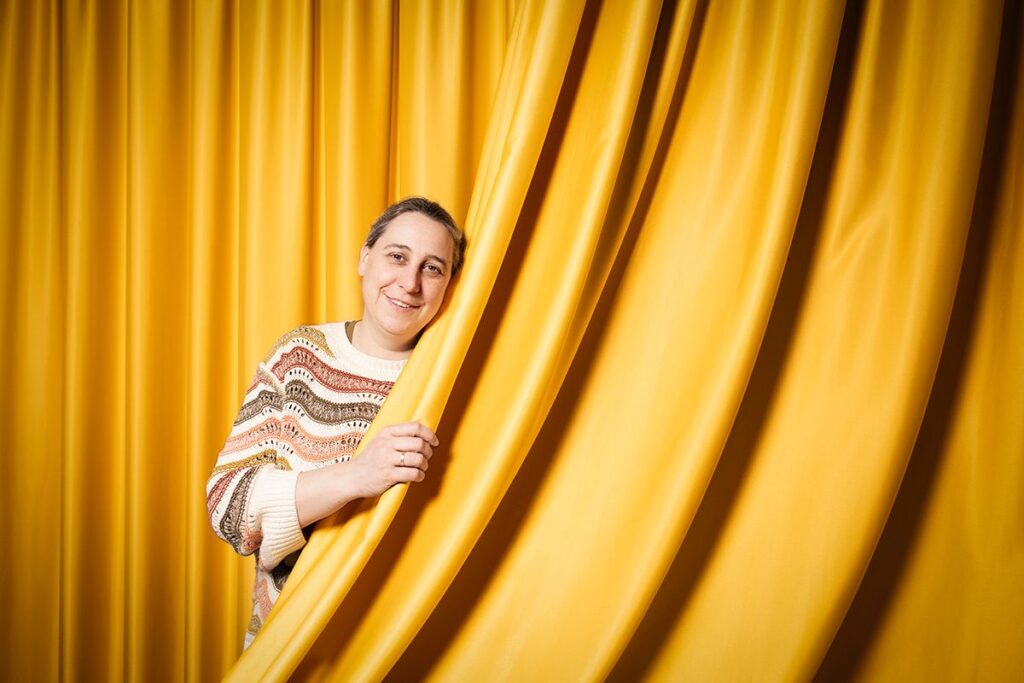

Mariecke van den Berg is Protestant and chose to stay with the church after discovering she is attracted to women, though she wrestled with that decision for a long time. Did she still belong in a church that excludes women and LGBTQ+ people? “I understand people who at some point say: this doesn’t work for me, I’m leaving my community. I’ve been at that point myself. But I decided to look for space within the faith, for alternative interpretations. For me, religion doesn’t have a normative function. My sexual values exist independently of my Christian background.”
She is now a professor of Religion, Gender, and Sexuality at VU and a professor of Feminism and Christianity at Radboud University Nijmegen. She represents a voice for non-conservative believers and works to highlight biblical texts that leave room for diverse sexual identities. “The Bible is not nearly as definitive as people often claim”, she says. “There isn’t just one biblical view on sexuality. The Bible is far too diverse for that. Polyamory and homosexuality, for instance, appear multiple times. I try to map that richness.”
Joking with parents
Still, not every Christian feels free to even speak openly about their sexual identity. At the Christian student association Ichthus, for example, no one was willing to contribute to this article. A pity, says Political Science student Alejandro Montaño Alvarez. He is Christian, took the time to complete the sex survey in detail, and is happy to elaborate. He is in a monogamous relationship with a woman, has sex 11 to 15 times a month, and rates his sex life a 10 out of 10.
‘Being conservative about sex is perfectly valid’
That raises the question: how does his sexual identity align with his religious identity? He speaks candidly: “I’m religious and come from a Catholic family. But it doesn’t define my identity, at least not consciously. I happen to be straight and to be in a monogamous relationship, but I feel free to express myself in whichever way I want. My sexuality takes priority over my faith.” Montaño Alvarez is Colombian and explains that religion plays a major role in his culture. “Still, my parents have always been open about sex. We had good conversations when my sex life began, and now we even joke about it together.”
Regulated sexuality
According to Van den Berg, Christianity has caused “quite a bit of harm” through the way sexuality has been regulated. And within other religions, too, there’s often a clash when it comes to sexuality. But she emphasises that even in secular contexts, sexuality and sexual identity are always regulated. “The work of Michel Foucault has given me a lot of insight into this. Even in a secular society, this kind of regulation exists. It’s about who can have sex with whom, at what age, consent, those kinds of ideas. We learn them, whether through religion, upbringing, school, or peer groups.”
Religious young people, Van den Berg observes, are more often forced to reflect on their sexual identity. “In the Netherlands, believers are a minority, so being religious already places you outside the norm. That creates, just like for transgender people, for example, a stronger need to shape your own story about gender and sexuality.” How do you approach sex and sexual orientation? What choices do you make, and why? While non-religious young people often explore these questions gradually over time, religious youth are pushed to take a stance earlier.
It’s a perspective that A. (22), a Muslim woman, recognises. “When I was younger, I did kiss boys occasionally. Back then, I didn’t fully understand what my faith says about it. But now it’s clear to me: I follow Islam and will wait until marriage to have sex. I think that’s beautiful: we’ll learn together, and it will strengthen our emotional bond. And honestly, I don’t feel the need for it yet anyway.”
Spiritually connected
H. (19), also Muslim, has made similar choices and is waiting until marriage. “Sex between a married man and woman is something intimate and beautiful. It’s the moment you become spiritually connected.” She doesn’t mind that she falls outside the Dutch sexual norm. “I’m not into parties or student associations. Most of my friends will probably wait until marriage too, they’re mostly Muslim. Of course I see sexuality in TV shows, but it doesn’t affect me. I don’t long for it.”
‘Sex is not a taboo in Islam’
A.’s friends, on the other hand, are not all Muslim, and some are already actively experimenting. “We can talk about it openly, I’m a very open person. Within Islam, sex is not a taboo; that’s a misconception. The taboo stems from certain Islamic cultures. I hope to be able to discuss it openly with my children in the future as well.”
Damaged for life
For outspoken Christians like Alvarez and Van den Berg, the key is exactly that: to keep the conversation about sexuality going, both within and outside the church. Montaño Alvarez hopes his attitude can inspire others, emphasising how important it is for this topic to be socialised and educated.
Van den Berg adds: “Being conservative about sex is perfectly valid, we’re fortunate to have that freedom in the Netherlands. But conservative voices are often the loudest, and that’s why they came to define the norm within Christianity, Islam and other religions. That’s where we need to be careful, especially with young people, because they’re vulnerable. When they feel like they can’t be themselves, it can damage them for life or push them to leave the church. And I’ve experienced firsthand that it doesn’t have to come to that.”