
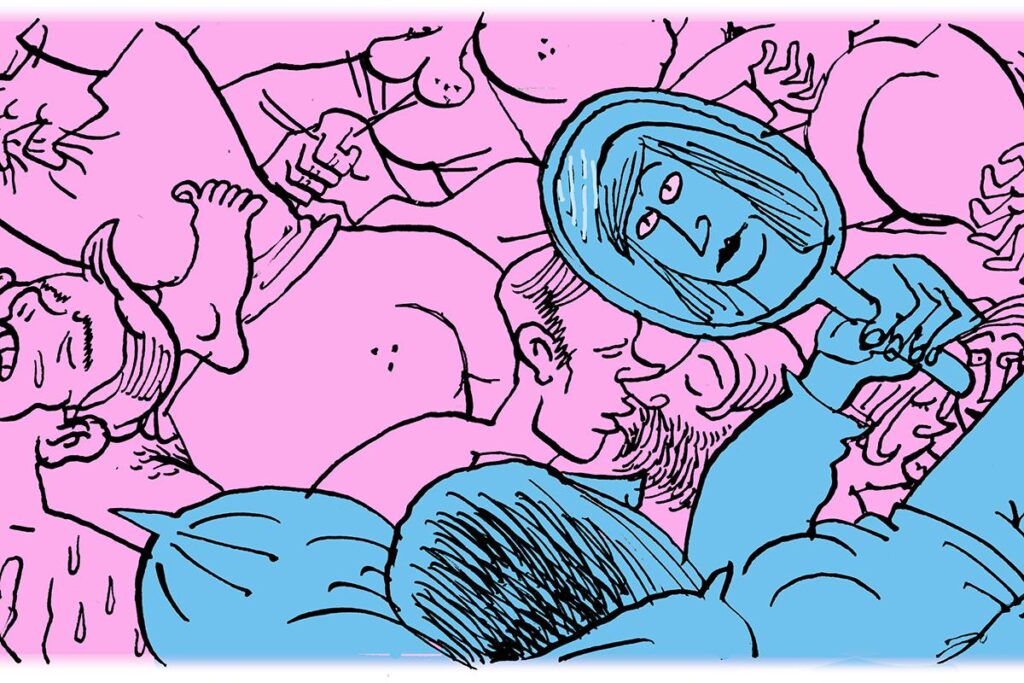

Tom is a second-year law student. To get more out of his student life, he joins the study association. There he meets Hannah. They become friends, and before long he develops a crush on her. After months of friendship, Tom gathers the courage to share his feelings with Hannah. Unfortunately, the crush isn’t mutual. Tom struggles to let go of his desires, and his unrequited love spirals out of control. He collects all available data about Hannah: her text messages, voice memos and videos, and transforms them into hyper-realistic pornographic images of her. They’re fake, but look lifelike. The images have been generated by artificial intelligence.
This fictional scenario is no longer a distant prospect. Generative artificial intelligence makes it possible to create pornographic material of someone without their consent. Actress Collien Fernandes, politician Sandra Beckerman and presenter Welmoed Sijtsma have all been victims of deepfake porn. It’s no coincidence that this is given a prominent place in the debate on AI porn. The technology also makes it possible to create porn of fictional people, thereby turning all imaginable sexual fantasies into digital reality. This raises not only ethical and legal questions, but also the question of what this porn technology does to how we relate to sexuality and sexual fantasies.
‘Why should watching porn be strange at all?’
A new form of pornography
Porn has played a role in our sexuality since the beginning of humankind. What started with cave paintings grew into erotic novels, sex magazines and pornographic films, and later evolved into things like phone sex lines, Chatroulette, OnlyFans and VR porn. It’s clearly not the first time that pornography has taken on a new form.
Inger Leemans, professor of Cultural History at VU, researched the rise of (literary) porn in the seventeenth century: “A great many people watch porn. Far more than we often think. And that includes women.” In one of her lectures, she shares that 35 percent of men and 20 percent of women watch porn at least once a week. Yet a taboo still surrounds it. Leemans questions this: “Why should watching porn be strange at all? Why should it be odd to think about something that is so important, sexual desire, but also reproduction, and to describe it and play with it? It’s a way of reflecting on what it means to be a sexual being.”
Less often naked
Since the 18th century, sex has increasingly functioned as a means of discovering things about ourselves. Leemans: “In the past, people in Europe mainly defined themselves through their family and place of birth, now they often do so through their sexuality. We’ve made sex a central topic of conversation and in doing so we keep trying new things. Porn feeds into this sexual journey of discovery: it makes people rethink themselves and their sexuality. In the 1970s, porn helped break sexual taboos, such as masturbation, the female orgasm and homosexuality. AI porn now makes us think about what’s real and what’s fake.” Leemans has the impression that talking about and experimenting with sexuality has become more difficult: “Because of social media and photography, we think more carefully about when we do or do not show ourselves naked. We’re afraid that images will be created that we’ll never be able to get rid of. That may be one reason why nude beaches are becoming less popular, saunas are scheduling swimwear days, and young people prefer not to shower naked after sports.”
A personalised journey of discovery
But what exactly is AI porn? It appears in a textual or audiovisual form and is generated using artificial intelligence. The textual variant includes chatbots such as Replika or ChatGPT, with which users can have erotic conversations. The audiovisual variant goes a step further: it makes it possible to create new, hyper-realistic sexual content based on existing images, featuring real or fictional people. These sexual images depict scenes that never actually occurred, but have been generated or manipulated. In other words, they’re ‘real fake’. According to Felienne Hermans, professor of Computer Science Education at VU, artificial intelligence makes it possible to personalise porn. That is the major difference from traditional porn: “With AI porn, you can adapt existing images. You can replace an actor from a porn film with someone you know, or even add yourself. You can also make everything ‘more perfect’: no birthmarks or wrinkles.”
More aggressive towards women
Hermans sees negative consequences of this malleability: “We’ve only just gone through a body positivity movement. It’s important that we see diverse bodies, such as bodies that aren’t slim, muscular, white or wrinkle-free. AI porn can make everything more extreme: women may be depicted as submissive even more often.” Hermans argues that sex has always been used as a means of committing violence against women and expects generative AI to be used for this as well: “Some men, for example from incel (involuntary celibate) culture, believe they’re entitled to sex with a woman. If a woman of flesh and blood doesn’t want to give them that, they create a woman of pixels and bits.”
Leemans also sees a backlash against women’s rights: “In history, you see that porn suddenly became more aggressive towards women when women emancipated themselves, for example around the French Revolution. That same trend can now be seen again in the manosphere.” Hermans also emphasises that users won’t be the only curators of their sexual fantasies: “Platforms ultimately decide themselves what content may or may not be created. In theory, they could, for example, ban biracial or queer porn.”
Addictive nature
Nana Ruedisueli is director of the Dutch Center for Sex Addiction. As a psychologist, she encounters the disadvantages of porn on a daily basis. She sees that watching porn affects our sexual development: “It’s an isolated activity instead of an interaction with a partner. It’s very passive. You’re hooked up to an IV drip of sexual stimuli: you don’t have to do anything, you only have to receive.” This makes watching porn very different from having sex with a person of flesh and blood. Ruedisueli finds it worrying that the contrast between physical sexuality and digital porn is growing with the rise of AI: “The urgency to develop sexual skills in real life is decreasing. These skills are becoming increasingly out of reach, almost an unattainable world, causing people to withdraw even more into porn.”
Solitary
Chatbots, for example, give the illusion that you’re having sex with a person: “Sex with a chatbot is solitary, but you do have a chat history with a chatbot that adapts to your desires and needs. It feels as if you’re in contact with a person, but you’re alone in your room.” Real sex can become more boring. It can be hard for real sex to compete with the stimuli that AI porn provides: “It can give the illusion that you have a fulfilling sex life. It can be interactive and you can tailor what you create to your own needs. That makes it easier to lose yourself in it: I want that type of body with that voice. It’s as if you combine a slot machine with a sex machine.” Ruedisueli is therefore concerned about its addictive nature: “There’s a group that’s vulnerable to losing themselves in this and losing control. The more advanced the technology, the larger the group that becomes captivated and vulnerable to this addiction to porn.”
‘Every new medium has a sex phase’
One-night stand or steady fling?
Is AI porn here to stay? “Every new medium has a sex phase.” According to Leemans, almost every medium uses sex as a way of testing itself and becoming successful. After all, sex sells. “Photography, video and the internet also had a sex phase. Moreover, the porn industry is always looking for innovation. Porn becomes repetitive over time and therefore less exciting. Home sex videos, amateur videos in which you see ordinary people having sex with each other, are an example of a trend with which the porn industry tried to excite people again: “People thought: oh, this is what the neighbours are doing; that’s new, so it’s exciting.”
The question is, therefore, whether AI porn will last or be a short-lived affair between AI and the porn industry. Leemans points out that new media not only try to sell themselves through sex, but also use sex to explore what the technology can do, how it affects people and where it derails. She explains that the debate about a new technology quickly turns to sex, “because that’s something everyone can imagine. If someone writes: Our children are being overwhelmed by brutal sex, everyone immediately understands what it’s about.”
Revenge porn
Whether it’s here to stay or not, AI is forcing us to rethink pornography. If you fantasise about sex with your crush, that fantasy normally doesn’t leave your mind. But if you can visualise these fantasies digitally using AI, it can. Hermans sees this as a risk: “The danger is that someone creates AI porn images of someone else, which then leave the computer. That’s how it can turn into revenge porn. The aim isn’t to please yourself, but to hurt someone else: to cause sadness and shame.”
Leemans also sees this risk: “The discussion of what is fantasy, what fantasy is allowed to be, and where fantasy must also be framed, is of course a very difficult one. At the beginning of porn, the discussion was about how porn undermined the church and institutions of society, but now it’s a very different question: am I allowed to say something about what goes on in your head? Where’s the line between fantasising and turning those fantasies into digital reality?”