
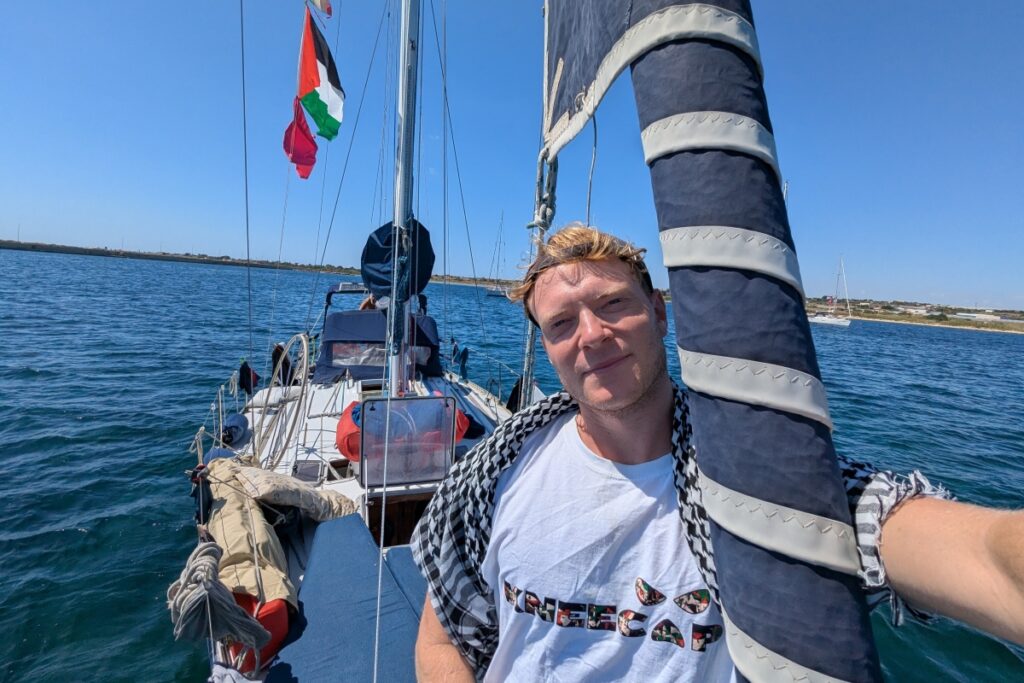

When Dario Crippa was sixteen, his parents took him and his brother backpacking through the West Bank. At a checkpoint, their bus was stopped. Because Crippa and his family had Italian passports, they were allowed to stay on the bus. Palestinian passengers were taken off and kept standing for an hour and a half, with a Kalashnikov pointed at them.
Back on the bus, Crippa gave his seat to an elderly Palestinian man. They started talking, and the man asked him to tell Europe what was happening to the Palestinians. “It felt like that was his only weapon – asking people to tell their story,” says Crippa. “That’s when I realised: I don’t need to be a journalist or the head of an NGO to deliver humanitarian aid or try to break a siege. We are all people of this world.”
Nine years later, Crippa himself is staring down the barrel of a Kalashnikov – this time on a sailboat, 130 kilometres off the coast of Gaza. The Israeli navy intercepted his boat Otaria, in the early hours of October 2, during the flotilla’s mission to deliver medical supplies and food to Palestine.
Six housemates in one room
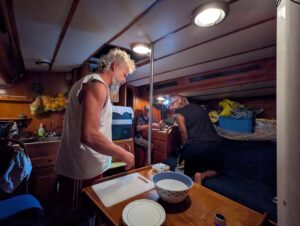
A month earlier, Crippa departed from Sicily on a small sailboat carrying (baby) food, medicine, and a six-person crew – people he had met only three hours before departure. It was a colourful mix, he recalls: “There was a seventy-one-year-old sea commander who used to rescue migrants in the Mediterranean, the director of one of Italy’s biggest newspapers, and a carpenter who builds exhibition furniture for Louis Vuitton.”
Participants could apply to the flotilla if they were sailors, doctors, journalists, social-media creators, or activists with a proven track record. During a two-week training on Crete, participants received sailing lessons, and the organisation selected those who turned out to be good team players. The final group was divided over the different boats in the flotilla.
‘Our group quickly became close’
Living together on a cramped vessel for weeks was not always easy. “It was like sharing one room with six housemates,” says Crippa. “Everyone naturally took on tasks like cooking or cleaning, but there were small irritations too – we had only one phone charger on board. If someone needed to make a call and found their phone unplugged, tensions rose. And the lack of sleep didn’t help.” Still, he felt safe with the crew. “When you share night shifts under the beautiful stars of the Mediterranean, you also find time to talk about your lives.”
Sound bombs
South of Crete, still far from the so-called ‘red zone’ where the Israeli navy often intervenes, Crippa is on a night call with a friend when he sees a red light approaching fast. Seconds later, a bomb explodes on the front of their boat. He and the captain are standing on the back of the boat. “During training we mainly learned what to do if soldiers boarded the ship,” he says. “In a way it’s less frightening when a person stands in front of you with a gun than when drones are flying above you and you don’t know how many there are or where they’re coming from.”
The Otaria survives unscathed, but other boats are too damaged to continue. The atmosphere on board grows tense in those moments, but he feels confident in the crew. “We were sailing so close to each other that you needed real navigation skills not to collide, but apart from waving or smiling, there wasn’t much communication between the boats. The bond with your crew was everything – and I trusted mine completely. I really felt we shared the same goal.”
Before departure, the activists had practised what to do in case of a takeover. The organisers pretended to be soldiers to teach the crews how to respond non-violently, even if violence was used on them. “The focus was on learning that what we were doing was legal and peaceful.” So weeks later, when Crippa sees dozens of navy ships approaching during his night shift, he calmly follows protocol and radioes the other boats. “Good wind and free Palestine,” he says — the last words before communication was cut. Then the crew throws their phones, laptops, money and anything else that could endanger them or others overboard.
Blindfolded
Crippa recalls how a group of soldiers, he can’t remember how many, board the Otaria, aiming their rifles while repeatedly demanding to know who the captain was. “We knew we had to answer some questions – who we were, where we came from – but not who the captain was,” says Crippa. “He could face additional charges for human trafficking.”
The crew is ordered to sit on the front deck all night. The only light coming from the rifles pointed at them, which the soldiers use as flashlights. “You know they probably won’t shoot,” he says, “but you still think about it.”
Eventually, four soldiers stayed on board as they were escorted towards the Israeli coast, moving the crew from deck to cabin whenever a cargo ship passed, to not raise suspicion. After seventeen hours of sailing and barely sleeping they arrive in Ashdod around noon. According to Crippa, activists from other boats that had been intercepted before them were already sitting there for hours in the burning sun without water. “The Israeli foreign minister walked between the rows of activists, followed by a camera, handing out bottles of water. But as soon as the filming stopped, the water was taken away again.”
‘We were just sitting there, 500 non-violent people’
After about three hours, exhausted from sitting on his knees, Crippa puts his hand on the ground to lean on it. A soldier kicks his arm away – twice. In front of him, climate activist Greta Thunberg is wrapped in an Israeli flag, pushed to the ground and spat on, while soldiers take selfies with her. “We were just sitting there, 500 non-violent people.” Nobody tells them how long they’ll be there or where they are going after. Eventually, Crippa is placed in an ‘Italian delegation’, where the soldiers curse them out in Italian as they question them.
Crippa is stripped of his hoodie, bound with zip ties and blindfolded. “Not knowing where they were taking me – that was one of the scariest moments.” He is led onto a bus, where other detainees are already waiting. “It was a relief to be together again. We took off our blindfolds and tried to reassure the newcomers.” The bus ride is freezing, as they blasted the air conditioning. The playing with the temperature to make the passengers uncomfortable is something VU student Mohammed Kotesh also recalled in his interview.
Hunger strike
In prison, he shares a cell with thirteen people and only eight bed, so he gives up his bed for a seventy-year-old man and sleeps on the floor. The drinking water makes them sick. “You could drink a little, then you got stomach pain, and an hour later you’d try again.” Communication with the guards is close to impossible. “Sometimes they replied to our questions, but often they just said we were not allowed to look at them. Most of them were Bedouins, people of colour, a minority in Israel who are badly treated themselves. It’s interesting how people who are segregated in their own society are placed in positions where they oppress others.”
 According to Crippa to exhaust them, the prisoners are continuously woken up throughout the night and constantly moved to different cells. “But that also meant we could exchange information. That’s how I heard there were big protests in Italy. I had no idea.” The Italian consul also doesn’t tell him that, when she visits him in prison. “She only said all the other activists had signed a declaration, stating we entered Israel illegally. She said if I signed too, I could go home the next day. If not, it might take a month.”
‘People who are segregated in their own society are placed in positions where they oppress others’
Crippa refuses to sign, “because it wasn’t true, and I didn’t want a dirty record.” Later, he learns that not everyone had signed after all. “But I understood those who did – everyone had a life to get back to.”
By the second day they no longer receive plates to eat from, so he scoops lentils onto a piece of bread. Their belongings and medicines are confiscated. Diabetics have no insulin; a cellmate coughs up blood but doesn’t get to see a doctor. Some activists go on hunger strike. Crippa decides to keep eating. “I believed it wouldn’t be good for my mental health. This way I also had more energy to help others.” He smuggles the water from the lentils back to his cell to give others some extra nourishment.
Blocked highways
Back home, his family keeps his Instagram account up to date, posting pre-recorded videos in which he says how many days he has been kidnapped by Israel. “I’d only recorded five of them – I grew a bit tired of finding quiet moments to film on a boat full of people.” The message he was allowed to send through the consul – that he was fine but also describing the prison conditions – never reaches his family. “It was as if they didn’t want that information getting out.”
After three days, he and the others are suddenly told they can shower. “That’s when I knew we’d be released soon – we had to look good for the outside world.” He believes the release came due to international pressure on Israel. “They don’t want the world to watch while we’re being held.”
When he lands in Milan, he is overwhelmed by the amount of support waiting for him. He is reunited with his parents and his girlfriend who had rushed over from the Netherlands. His inbox is full of emails of concerned fellow students and teachers, who also flooded the VU executive board of the VU with messages.
‘I kept thinking: look what they’re doing to us — Europeans with passports and media attention. Imagine what they are doing to Palestinians what’s never seen or talked about’
In his hometown Bergamo, people had blocked highways and train stations in solidarity with his imprisonment, “something that hadn’t happened in forty-five years. There were grandparents among them, and not just the far-left for instance,” says Crippa. “That’s why I think the flotilla was a success: people who never talked about Palestine are talking about it now. I kept thinking: look what they’re doing to us — Europeans with passports and media attention. Imagine what they are doing to Palestinians what’s never seen or talked about. That’s why I’ll keep doing activism”, he says. But, laughing: “I also really want to finish my master’s.”