
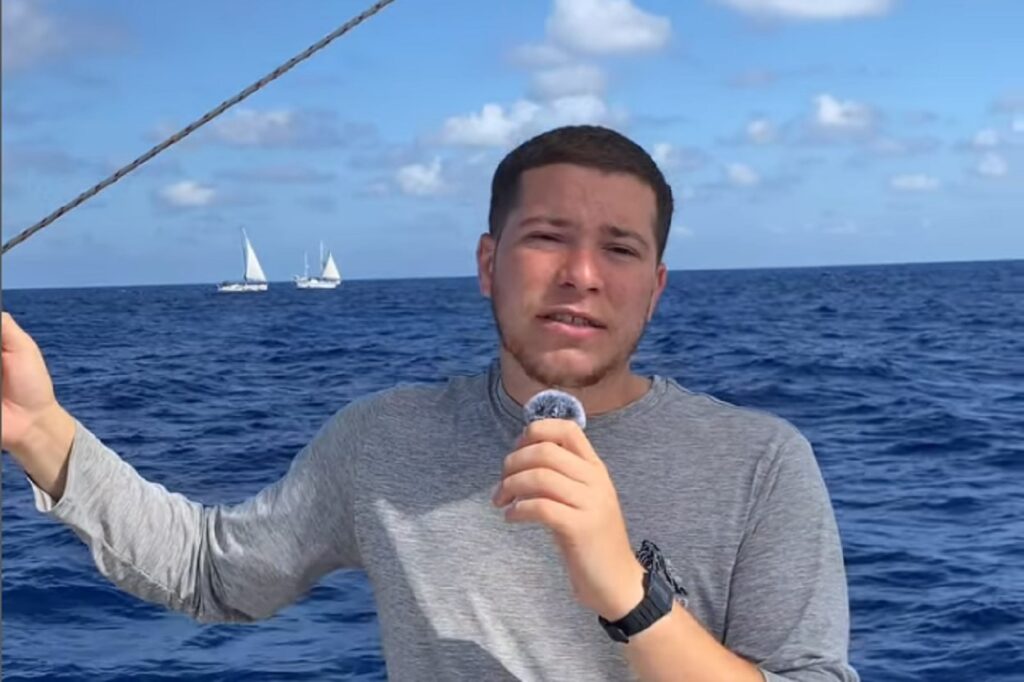

The first two times Mohamed Kotesh (Mo) attempted to join a Flotilla aid mission to the occupied Palestine he yielded to strong advice against his participation – it would be too dangerous. Kotesh is an activist and Computer Science student at VU. He is of Palestinian origin and holds Dutch citizenship, but between his birth in a Palestinian refugee camp and gaining a Dutch passport, Kotesh was considered stateless. In his third attempt to join a flotilla, he was unmoved by appeals to danger: for him, “there’s nothing more to spare.” One month and thousands of miles later, he knows that the people who advised against him going were right.
The Global Sumud Flotilla was a fleet of 42 boats, which set sail to Gaza to provide vital medical equipment and nutritional aid amid the ongoing famine. The 42 vessels brought together people from over 57 countries. Considering likely intervention by the Israeli Defence Forces (IDF), each citizenship endowed different privileges and risks.
Perceived immunity
Kotesh coordinated a Dutch boat in the Global Sumud Flotilla called Mohammad Bhar, named after a Palestinian man with Down syndrome and autism who was killed by an IDF army dog. Kotesh sailed the Mohammad Bhar to break Israel’s siege of Gaza, to protest Dutch complicity in Israel’s genocide – including the Netherlands’ supply of dogs to the IDF – and to return to the home he had never been to.
Kotesh’s boat departed from Greece on September 2 and was intercepted by Israeli forces on October 2. During their month at sea, the flotilla members maintained a hopeful yet stern social media presence, sharing sentiments of hope and excitement about reaching Gaza’s shore. The tone of these messages shifted after being intercepted by Israeli forces. Pre-recorded testimonies from Kotesh and other Dutch participants on their social media accounts revealed their fears about Israeli prisons and emphasised the legality and importance of their mission. For Kotesh, the fears were graver than those of the others. Being Dutch, he was untouchable, but being Palestinian, his mere existence was endangering.
Maccabi Tel Aviv riots
After having been intercepted, the activists of his and other boats were taken to Ashdod Port in Israel to be questioned. Soon thereafter, Kotesh’s Palestinian origin was revealed, and he was separated from his fellow Dutch sailors. According to the Israeli officers, “[the name] Mohamed and the Netherlands don’t go together.”
Kotesh found himself surrounded by Israeli police and Mossad officers, Israel’s national intelligence agency. “You say you are from Palestine, but Palestine doesn’t exist”, one agent said to him. Other agents told him they were fans of Maccabi, an Israeli football team, referring to the November 2024 riots surrounding the Maccabi v. Ajax football match in Amsterdam during which both Israeli Maccabi fans and Palestine sympathizers were attacked. Kotesh, because of his activism, was linked to the riots in a special report published by the Israeli Ministry for Diaspora Affairs and Combating Antisemitism.
Intangible violence
Kotesh says the police cut off some of his clothing. While taking a photo of him, an agent warned him: “Maccabi fans are coming today for you.” Kotesh recounts then being blindfolded, tightly handcuffed, and placed in a bus alongside a Tunisian and a Moroccan activist. Kotesh was the only one blindfolded and cuffed. Inside the bus, they endured extreme temperature fluctuations. The chamber was a “high temperature, and then very, very low, very, very high, very, very low.” Kotesh had to cope with dwindling blood circulation to his hands and the hunger and thirst after twelve hours without food or water. He was separated from the others and told he was being taken to a separate prison. Severed from contact with both members of the Mohammad Bhar boat and the Dutch embassy, Kotesh was swallowed by loneliness and fear.
On the way to the prison, temperature fluctuations continued. The ride stopped, and a fatigued Kotesh was put into a cage outdoors. He describes an interaction with Israeli officers: “Everyone was taken somewhere else, and I was in a cage outside, still handcuffed and blinded. I think half an hour later, [an Israeli officer] appeared, came to me, and [said] ‘You love killing Jewish babies.’ So, I only answer with ‘No’ and kept my silence. Then he went away after taking the photo or video he wanted. Another half an hour later, I hear six guys in front of the cage saying ‘Let’s go and kick the shit out of him.’ And suddenly their supervisor shows up and tells them not to do so, because I have a Dutch passport.”
Kotesh was later taken to a doctor who recommended his handcuffs be removed to prevent bruising. According to Kotesh, they didn’t want the world to see what they were doing to him: intangible violence, designed to leave no stain. He jokes that this is the “VIP treatment” he got in his first 24 hours on Palestinian soil.
Paradoxical advantage
Kotesh is disappointed by how he was processed by the Dutch consulate. He says they could clearly see the marks that remained on his wrists, but ignored them and did not react to the fear he experienced in his treatment by Israeli officers. He attributes the consulate’s attitude to “the complicity of the Dutch government.” At the same time, that Dutch complicity vaccinates its passport holders against the worst consequences of torture and genocide. Kotesh straddled this paradoxical advantage and the existential risk of being Palestinian. “Israel refuses our existence. Being on that flotilla and putting my feet on Palestinian soil was a form of resistance.”
Despite the dire circumstances, hope has a pulse. Kotesh describes the Israeli prison: “I never saw so many differences between people: people of different ages, with different religions and backgrounds – all the differences that you can imagine were there. And the only thing that did unite us is that we wanted to fight this injustice and stop this genocide.”
‘Don’t look away’
The diversity of the movement demonstrates its resilience. Despite failing to deliver aid, the mission of the flotilla resonated internationally and has attracted the support of millions. In Gaza, people were able to fish off the coast because the IDF was busy with the flotilla. That alone, made the journey worthwhile for Kotesh.
The warnings Kotesh received about participating in the flotilla were accurate, but he still plans to return to Palestine, as well as continuing his invigorated activism for Palestine in Amsterdam and beyond. Simultaneously, he will work towards his Computer Science degree at VU. Since his 24 hours in Palestine, Kotesh’s fight against injustice has only increased. His message to the world: “If you look away from Palestine, or if you’re looking away from injustice which is being done to someone else, believe me, you will be next.”