
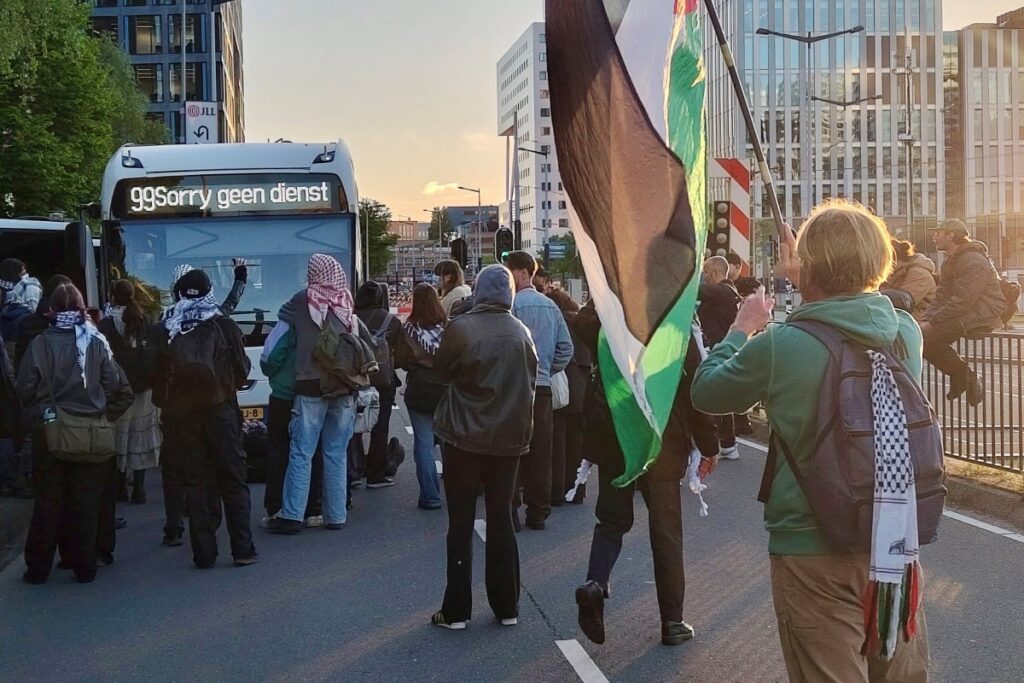

On Monday afternoon, a small-scale protest on the campus square by VU for Palestine escalated into the occupation of the BelleVUe building and the executive corridor in the main building. The activists demanded that VU disclose all ties with Israeli institutions and sever them along with other defence-related partnerships.
Kealey Hartland, deputy chair and secretary of student union SRVU, served as liaison between VU and the protesters. “VU proposed that the occupiers leave the building at 15:45 to continue their demonstration on the campus square. At the moment I was about to relay this to the protest group, an arrest team with police dogs drove onto campus. Where we thought VU was going to de-escalate after its own proposal, they chose escalation instead: more and more police vans arrived on the campus square, including police dogs. The protesters therefore no longer felt safe leaving the occupied buildings. Especially because last year a student was bitten to the bone by a police dog at a similar protest in Nijmegen, leaving them permanently disfigured.”
Trespassing
After issuing several warnings over the course of the evening, VU filed a police report for trespassing. Police officers then entered the occupied BelleVUe building around half past seven with batons and cleared it. An hour later, the executive office area was cleared as well. According to a spokesperson for VU for Palestine, all 22 of those arrested have since been released.
Despite Hartland’s request to VU spokespeople to talk with the activists, that conversation never happened, she says. “The demonstrators wanted to talk to VU. That’s why they staged this occupation: to be heard. It seems normal to me that in such a situation you talk to these students, rather than immediately sending the police after them and ultimately using violence against them.”
Baton strike to the neck
The occupation was turbulent at times. While arrested protesters were being led away, bystanders blocking the vans received hard blows from officers wielding batons, as can be seen in the video below on Instagram.
Dit bericht op Instagram bekijken
A protestor told Ad Valvas how an officer struck her in the neck with a baton. Her neck was red and swollen, and immediately after the blow she felt dizzy and struggled to stay on her feet.
Another protester needed a sling for his arm. At the end of the evening, a student with diabetes was denied access to the main building, where her insulin pump was located — an essential device for diabetes patients. Eventually someone inside the building was able to bring the insulin pump out to her.
‘Disproportionate force’
A VU for Palestine (VfP) spokesperson called the police’s use of force disproportionate. “They were hitting people with batons, including overhead strikes. That’s clearly not allowed.” The police had been present on campus since early in the day and mainly looked on until the decision to clear the buildings was made. Officers told Ad Valvas they were there for safety, in case a fight broke out or a counter-demonstration appeared. “We had a very different experience,” the VfP spokesperson says. “Whose safety did they protect? In my view, mainly VU’s — to maintain its ties with Israel. If they’d been there for our safety, they wouldn’t have intervened so harshly.”
But what if people refuse to leave a building and the police’s requests go unheeded? “How they carry out a proper eviction is not our priority. Our priority is to put as much pressure on VU as possible to cut ties with entities that enable genocide. Other universities have shown it can be done. The UvA did not renew certain exchange programmes, for example, and the KABK in The Hague severed ties with Israel. But collaborations with Israel are often maintained because of financial interests. Education budgets are being cut, and universities are filling the gap by partnering with Defence. Military technologies generate a lot of money.”
Agitated security guard
While most security guards seemed to have the best interests of both the protesters and the staff working in the BelleVUe building — including Ad Valvas editors — things also went wrong. Instagram footage shows a security guard being calmed down and physically restrained by a colleague. He utters threatening words; according to the person who posted the video, he even threatened to hit protesters. “This is a demonstration, it needs to be facilitated, however inconvenient that may be,” someone calls out off camera.
Dit bericht op Instagram bekijken
Later that day, the same security guard was stationed at the entrance to the occupied executive offices, where he called protesters “stupid” and said they “have the brains of ants.” A VU spokesperson responded in writing that they cannot comment on individual cases. ‘We will review the video and, if warranted, speak with those involved,’ according to a spokesperson.
Hartland has heard troubling reports from the protest group about the security team’s conduct. “I raised this with the VU spokespeople yesterday too, including that a security guard had allegedly been physically aggressive. The VU spokespeople then spoke with security and assured us that everything was now in order. We hope to have a proper conversation with VU about this soon, where there is room to share each other’s concerns.”
‘Police intervention necessary’
According to VU, protest is permitted as long as house rules are followed and the safety of students, staff and visitors is not endangered. ‘Occupying a university building and wearing face-covering clothing do not fall within those rules,’ the VUwebsite states. VU says it supports constructive dialogue with respect for each other’s positions. ‘Unfortunately, circumstances today left us no other choice, and police intervention was necessary to safeguard safety and order on our campus.’
The VfP spokesperson calls bringing in the police “a bizarre move.” “If you consider the concerns of the demonstrators — who want to uphold human rights and prevent the university from becoming complicit in sustaining genocide — and you then send police after them like some kind of guard dogs…”
The occupation did have an effect, he says. “The issue is back on the agenda. The two occupations were preceded by all sorts of other forms of protest: walk-outs, teach-ins — but those didn’t accomplish anything. The fact that this was a more disruptive action, I think that’s justified. We hope VU feels the pressure.”
Not violence but dialogue
Protesters from outside VU were also present at the demonstration. Would it not have been better if only VU protesters had been there? “VU often hides behind these kinds of arguments to suppress protests like this,” Hartland says. “Especially in this time, when repression against students is becoming greater and more visible, with police deployment and violence. Why don’t they have a conversation with students? Why does it have to involve batons? Students don’t deserve that. The campus is not a place for police and violence, but for dialogue, academic freedom, and development.”
Hartland therefore wants to sit down with VU soon to discuss how the demonstration unfolded and what should have been done differently. “I hope for an open conversation, where there is room to share each other’s concerns.” After the previous occupation, that was the plan as well: for the executive board to enter into dialogue with the students involved. But those conversations stalled quickly. VfP spokesperson: “We want to have the conversation, but we are not going to compromise on ties with institutions that contribute to a genocide.”
VU’s response
‘The occupation was discussed multiple times with liaisons of the protesters. At present, no new conversations have been scheduled. We have invited the protesters’ liaisons for a follow-up meeting. Exits were barricaded, obstructing free movement through the building and severely limiting the ability to leave the premises quickly and safely in the event of an emergency. Combined with the threatening atmosphere and the wearing of face-covering clothing, this led to an unsafe situation in which the safety of protesters, staff and students could not be adequately guaranteed. Project partnerships can be found online. Our policy remains unchanged; more information can be found on VU.nl. As a university, we have no authority over how the police are present. However, we did discuss this with the police, after which the police dogs were repositioned further away on campus.’