
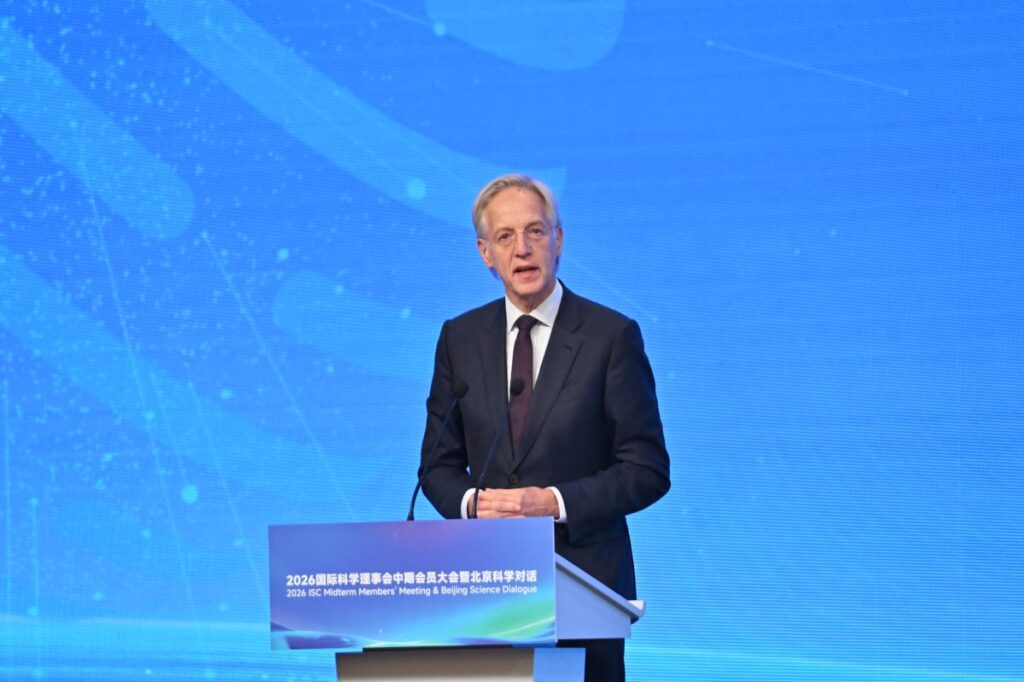

Physicist Robbert Dijkgraaf, who gave up his job in Princeton to become the Netherlands’ Minister of Education on behalf of D66, still thinks of himself as a scientist. This week he flew to Japan, the US and China, and wondered: would all those jet lags cancel each other out?
That hypothesis has been disproved, he says with a wry laugh. If anything, the jet lags turned out to reinforce each other. We speak on the phone when it is Friday evening in Beijing. Dijkgraaf has just taken over the presidency of the International Science Council from his New Zealand predecessor at the organisation’s congress.
“In the Netherlands, perhaps few people know the ISC, but here in China it is well known,” says Dijkgraaf. “Chinese science has developed spectacularly in recent years.”
Figurehead
For the next four years, Dijkgraaf will be the figurehead of international science. He will advise the UN Secretary-General and travel from country to country to speak about the importance of academic freedom. He will do this alongside his professorship at the University of Amsterdam.
The ISC was formed in 2018 through a merger of two international science councils and is headquartered in Paris. Its 266 members – academies, scientific unions and other organisations – come from almost every country in the world.
“We want to stand up for science,” Dijkgraaf explains. “Almost everywhere, we see that the freedom of scientists is under pressure. We are already feeling that in the Netherlands, but colleagues in other countries are feeling it far more. International cooperation, for instance, is increasingly seen as a risk to national security.”
That is a striking message from someone who, as minister, proposed screening students and researchers from high-risk countries. His aim was to prevent knowledge theft and protect national security.
The KNAW still cites your bill on knowledge security as the example of a government threatening academic freedom.
Dijkgraaf: “But in the end, that bill was never submitted. We were criticised, including by the KNAW, and we listened. I said so afterwards, too: scientists should really decide on this themselves, because they have the necessary expertise. They can determine with surgical precision which knowledge needs protecting and which does not.”
So have you changed your mind?
“We shouldn’t slam doors shut unnecessarily. Make no mistake: in 1985, China accounted for less than one per cent of global scientific output; now it is a third. It is in the Netherlands’ interest to keep access to that knowledge.”
‘If you start throwing countries out of the ISC, you soon end up with a very small club’
In 2022, you were Minister of Education when Russia invaded Ukraine. You asked higher education institutions to end all cooperation with Russia immediately.
“Yes, that was a political decision by a democratic government. But the ISC is not an association of countries or institutions. We are simply scientists from all over the world. There has to be somewhere countries can talk to each other, however difficult relations may be.”
So you don’t throw countries out?
“We still have the science academies of both North Korea and South Korea as members. The Israeli and the Palestinian ones. We have Russia and Ukraine. China and Taiwan. That is highly sensitive, and they may well give each other a wide berth, but if you start throwing countries out, you soon end up with a very small club.”
What does their membership achieve, then?
“Contacts between scientists are still possible where political ones no longer are. For example, there are researchers from the United Kingdom and France studying a gigantic volcano in North Korea that could erupt at any moment. It is in all our interests to know what is happening there. The same goes for the next pandemic: wherever in the world it emerges, everyone will want information about it.”
Do you think that kind of cooperation can lead to peace?
“Of course, I don’t know whether we will ever manage to wage less war. But a good example from the Cold War is the International Geophysical Year. Earth scientists from the US and the Soviet Union began working together and, among other things, paved the way for the Antarctic Treaty, in which the two powers agreed to keep the South Pole free of military installations. That is quite remarkable. It may not happen often, but it is the gold medal of science diplomacy. Sometimes we can help bring peace.”
Dijkgraaf has more examples of striking international cooperation. On the International Space Station, astronauts from both Russia and the US float side by side. In Jordan, scientists from countries including Turkey, Egypt, Pakistan, Israel and the Palestinian territories work together at the SESAME particle accelerator.
Dijkgraaf: “Geopolitics is about economic interests and security. Science is rarely mentioned, even though academic freedom is declining worldwide and cooperation is being cast as suspect. That is why we, as scientists, have to take to the stage ourselves.”