
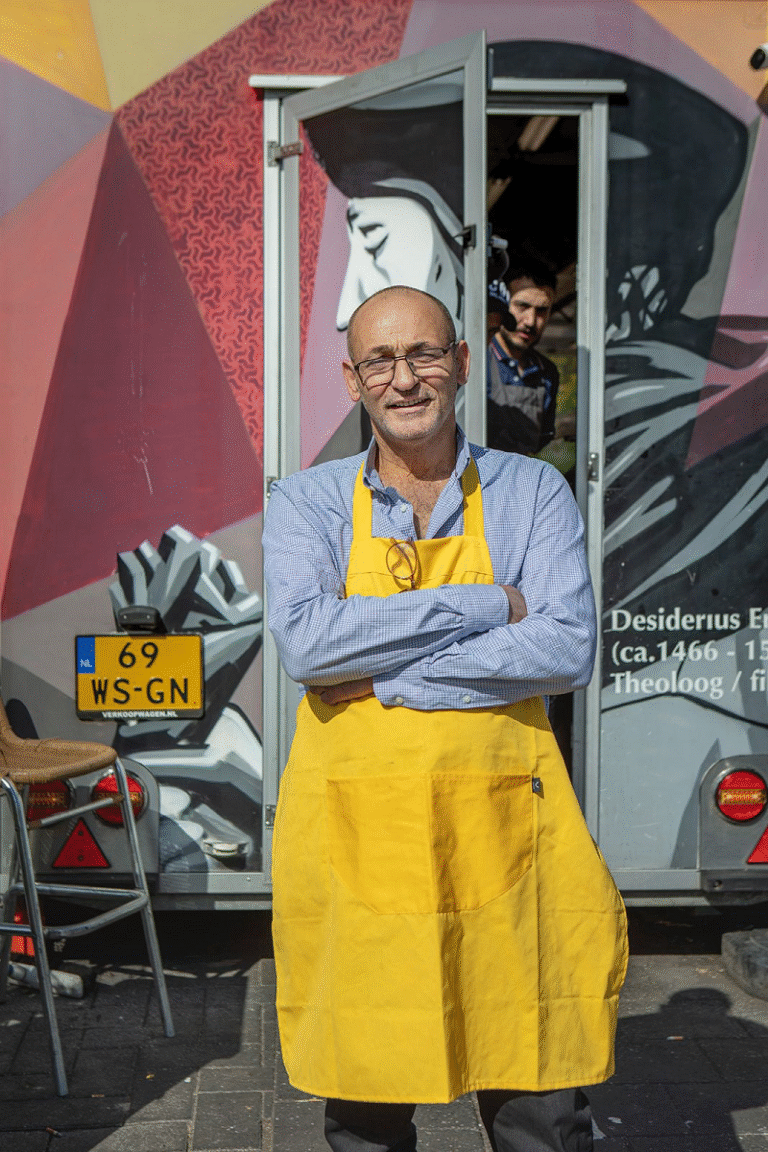

Daily Snacks
Every day, Adib Edlbi commutes from Rotterdam to his kebab stall, Daily Snacks. At 15, he started working in the kitchen of a restaurant in his hometown of Damascus, Syria, and has worked in hospitality ever since. Edlbi came to the Netherlands in 2000 and started selling kebabs at markets around Rotterdam in 2002. In 2008, he and his wife opened their own kebab stall in Amsterdam, starting on the east side of Parnassusweg before moving to the intersection of Parnassusweg and De Boelelaan in 2017.
Who are your customers?
“Half of my customers are students, the other half are construction workers, VU employees, tram drivers and local residents. I love young people, even though I’m not that young anymore myself. My younger colleagues are friends with everyone. They know the standard orders of our regular customers, and who wants extra sambal or no tomato. The customers who come here most often are students who don’t feel like eating a sandwich, which I understand. Nowadays, every student has a side job, so they have the money to buy their own food.”
What do you enjoy about working with young people?
“Look, I’m old and I complain a lot, ha ha! Young people are the best customers. Why? Because they’re always hungry! They’re healthy, they want to taste everything. I can’t eat much myself – if I eat a little more than usual, I put on weight. Young people don’t have to worry about that, even if the food is a bit greasy.”
Why is your stall such a success?
“It’s hot food that’s tasty and filling, and we’re not expensive. At some of the other places around here, you pay two or three times as much, and our portions are bigger. The most popular item on our menu is the kebab. If you get that without bread or fries, so just vegetables and meat, it’s also quite healthy.”
Do you have vegan options as well?
“Absolutely, we have two vegan options: falafel and a broad bean salad – a tasty Syrian dish with tomatoes, parsley, onion, lemon and olive oil. We also have a variation with pureed broad beans, chickpeas and a yoghurt-tahini sauce. Falafel is more popular because it’s better known, but I prefer the broad beans. And it’s not fried, so it’s healthier too.”
I think a lot of people love your stall.
“Our customers are very friendly, and I get a lot of nice compliments. People tell me the food was delicious, or that they’ll definitely be back. Sometimes students come to say goodbye when they graduate because they’ve been coming to my stall since their first year. One student from Indonesia, who was Muslim like me, even gave me a prayer rug as a parting gift.”
Is this intersection opposite VU Amsterdam the perfect place for you?
“We’re doing well here – I now have four employees. But the council has told us that we have to leave here in two years. I’d like to stay near the university. Maybe in a kiosk, although I’d prefer to stay in this stall – it cost me €100,000.”
What does the future look like for you?
“I’m 55 now, so if I can keep doing this for another ten years I’ll be happy. It’s a lot of work: we’re open six days a week and I work twelve hours a day. When it’s really busy or if one of my colleagues is sick, I work fourteen hours a day. But I hope to be able to keep doing this work – I’ve been working in the hospitality industry since I was 15. In Syria, I also made pastries similar to baklava. My dream is to pick that up again, but there has to be demand for it and it has to be profitable. And this stall provides for a family of five, so I can’t just risk our income. But who knows.”
Adib Edlbi (55)
2008 – present
Owner of kebab stall Daily Snacks, Amsterdam
2002 – 2008
Market stall operator, Rotterdam
1985 – 2000
Chef, Damascus, Syria