
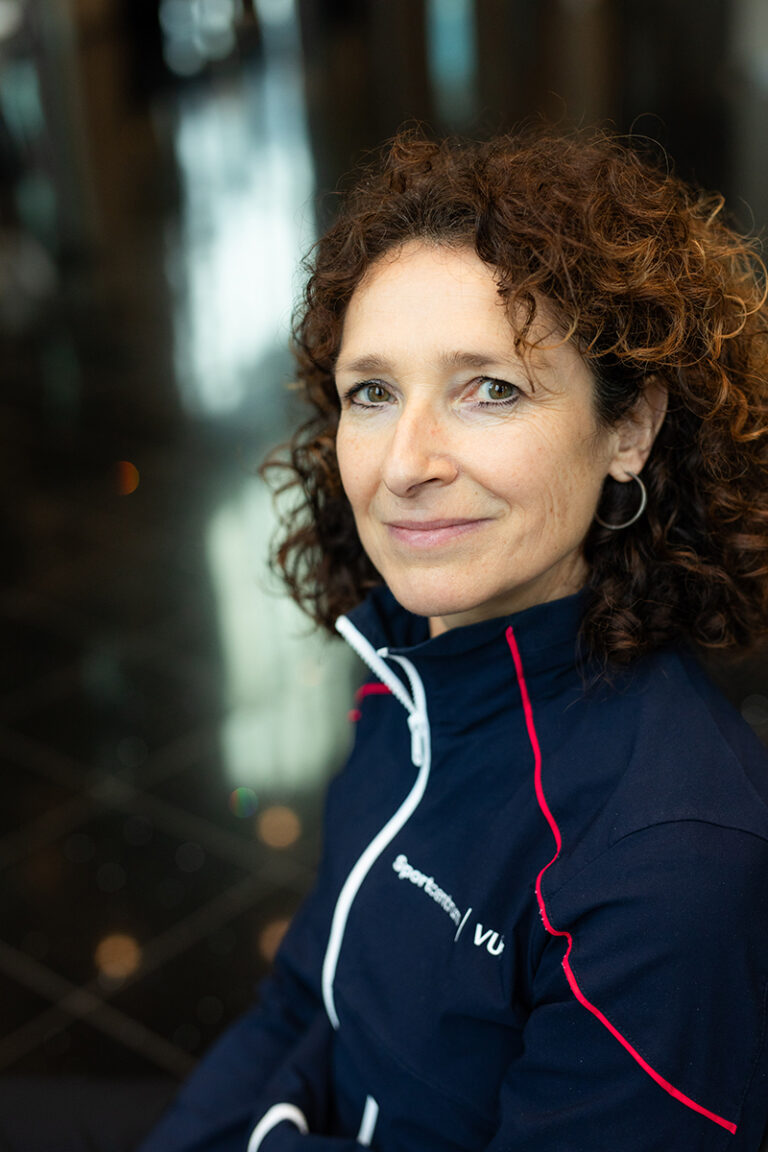
What exactly does a movement and lifestyle trainer do? “My job combines actually training with people, educating people about a healthy lifestyle and contributing to policies. As a fitness trainer, I conduct intakes, which means I listen to people’s stories, carry out tests and draw up a programme for them. I’m also available as a personal trainer, in which case I’m present at every session. But that costs extra money. In addition, I support people who are ill or have a disability, I give tennis lessons and I assist staff members who come to the Lifestyle Desk with questions.”
What questions have people already contacted the desk with? “I recently talked to someone who was having trouble sleeping. He found it hard to fall asleep and, once awake, couldn’t get back to sleep. Together, we looked at what might be causing this. It’s too personal to go into detail here, but if you want to improve your sleep, you’ll soon find yourself reflecting on relaxation, exercise and diet. For example, you can improve your circadian rhythm by getting up early, going outside and getting exercise at regular intervals.”
VU Lifestyle Desk
Relaxation, nutrition, exercise, sleep and mental resilience. Anyone struggling in these areas of life can turn to the VU Lifestyle Desk. There, they can book a free half-hour consultation with exercise and lifestyle coach Mariëlle Spekreijse. The desk is part of VU in Motion and Sustainable Employability, and is open every Tuesday and Thursday from 3.00 PM to 5.00 PM.
What other questions did you get? “Another colleague was struggling with her eating habits. She wondered how she could stop snacking all day long, as it made her feel unwell and caused energy spikes and dips. Often, this is down to processed carbohydrates, specifically fast-acting sugars. I used to eat sandwiches all day long too. Sometimes my legs would shake and I’d have to put something in my mouth straight away. Now I eat two or three times a day, and my energy levels feel much more stable. People find it a real eye-opener that eating less a day gives you more energy. Your body fat percentage drops too. That’s not just a consequence of what you eat, but also how often you do so.”
So diet, exercise and relaxation are always interlinked. “I started out as a movement scientist, but I’ve since become convinced that you need to take a holistic view of health. It’s always about the whole person.”
Which groups are at risk? “Staff who work at computers are generally at the greatest risk of health problems, and at a university, that’s pretty much everyone. Last year’s Vitality Scan identified younger VU staff, including PhD students, as a vulnerable group who experience high levels of stress and have unhealthy eating habits. The same survey also showed that women suffer significantly from an overload, both mentally and physically. You can’t separate the two.”
The VU has been encouraging staff to exercise more for years. Surely people can come up with that idea themselves? “You want people to spend all those hours at VU in a healthy way. You want them to break up their sitting time every hour and get thirty minutes of moderate-intensity exercise each day. It also leads to better concentration and focus, and less absenteeism. There are calculation tools that clearly demonstrate this: if a certain percentage of employees take a certain number of steps per day, or cycle a certain number of kilometres to work, this results in a certain percentage reduction in absenteeism and an increase in productivity. Not to mention the improved mood that comes with being active.”
How do you know whether these exercise programmes are effective? “That is indeed unclear. It requires additional budget, time and manpower. We would like to commission research into staff needs and the programme’s impact. Also because we want to reach more staff. Recently, I organised the ‘Up the Stairs Together’ event, where we climbed fifteen floors to the church hall in the main building. It was great fun, but only twenty people turned up. Ideally, you’d want a hundred. We are now in discussions with the executive board about how we can increase our impact.”
Mariëlle Spekreijse
(56)
2024 – now
Training to become a kPNI therapist (Clinical Psycho-Neuro-Immunology)
2023 – now
Project leader of VU in Motion
2001 – now
Developing products and working with clients in the field of exercise and lifestyle
1995 – now
Tennis coach
1989 – 1994
Study Human Movement Sciences at VU
1985 – 1990
Handball player in the Dutch national team