


No obvious two-way race this time. Last year, the left-wing ChangeVU and right-wing Vrijmoedige Studentenpartij (VSP) went head to head. The only independent candidate didn’t get enough votes for a seat. VSP secured 2 seats and ChangeVU 9. This year VSP is not running (see box below), and two new parties have entered the arena.
ConsensusVU: new party represents ‘the reasonable middle’
One of those parties is ConsensusVU, founded by former student council chair Anne Bruggink and former vice-chair Oskar Siri, who also stepped down. In February, they left the University Student Council (USR) because the fallout from the misconduct of two VSP members had created what they considered an unworkable situation within the council. They also left their party ChangeVU, where fellow members had called them ‘puppets of the Executive Board’. “Trust has been irreparably damaged,” Bruggink said at the time.

At the end of March, just before the usual campaign period, Bruggink and Siri launched their own party: ConsensusVU, with which they say they want to return the participational body to its original purpose. “We want to shift the focus from differences to common ground. From fighting each other to fighting a problem together.” ‘End the duel,’ they write on their Instagram. According to Bruggink, by this they mainly mean the duel between ChangeVU and VSP. “An atmosphere has emerged of wanting to defeat the other party. In our ideal scenario, there would be no parties at all, just individual candidates running on behalf of students. So in a way it’s strange that we’ve now started a party – it’s exactly what we want to move away from.”
According to Bruggink, the participational body has a legal duty to represent students, but she says that duty was compromised by council members fighting each other. As an example, she cites a discussion within the USR about whether or not to post an Instagram message about the Gaza flotilla. When she wanted to hold off until they could discuss it in person, other members concluded, according to her, that she was then complicit in genocide. “I understand that emotions can run high, but you have to be able to keep talking to each other about these kinds of things.”
Depolarisation is therefore a major pillar for the party. But isn’t that also a tactic to avoid difficult topics? “No, you’re allowed to hold a strong opinion and stand behind it, but verbal violence, intimidation and bullying are unacceptable. The conversation has to take place in the middle – where you both move towards each other.”
Isn’t that a difficult theme to campaign on? Most VU students won’t be aware of, or affected by, the atmosphere inside the student council, and may be more receptive to concrete plans for the campus. “That’s why our candidates determine their own main points. And we strongly advise them to be respectful in doing so.” That’s also why they deliberately started small and see this as a ‘pilot year’. No online recruitment campaign, but a handful of people they approached personally to stand as candidates. One of them is now on the list. Bruggink isn’t worried that candidates will come up with controversial points the party can’t get behind. “Otherwise they’d just run independently.”
Overarching themes from ConsensusVU are, in any case, depolarisation, academic freedom, social safety and accessibility. “Students sometimes don’t even dare to ask a question in a seminar anymore, because they can be judged for it. I don’t think everything should be sayable – certainly not when it hurts people. But there does have to be a grey area in which you can form your opinion.”
VU Student Coalition: new party for ‘unheard students’
On their Instagram, VU Student Coalition highlights the themes that matter to them. They don’t yet have a party programme. The party has been active for several years at Erasmus University Rotterdam and Utrecht University, but the VU chapter has only existed since this year. Their wishes are clear: a socially safe campus that is sustainable, affordable and inclusive, with transparent decision-making, accessible mental health support and good career guidance for students.
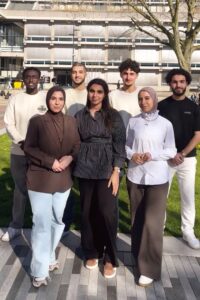
Exactly what all of that looks like in concrete terms can’t immediately be read on their Instagram. According to lead candidate and bachelor’s student Esraa Aboelkasem, that’s mainly a matter of keeping the Instagram updated. The campaign period coincided with exam week – there wasn’t always time for everything right away. But according to Aboelkasem they have been busy with “preparations” since October: shaping their substantive themes and priorities and “actively listening” to various student perspectives on campus – through student associations, for example.
In a conversation on campus, she explains the party’s wishes: to make the campus affordable for everyone, the VU canteen should be able to offer students a meal for 2 or 3 euros, and printing costs need to come down. According to Aboelkasem, some lecturers ask their students to bring printed papers to class, to prevent them from using AI. That way, it remains a laptop-free zone. “But if you have to print a number of papers every week, those costs can really add up.”
There is also ground to be gained, according to Aboelkasem, when it comes to supporting students’ mental wellbeing. On top of worries about finding housing and declining purchasing power, students are also affected by geopolitical tensions, she says. “To make support inclusive, it also has to be culturally sensitive and take the student’s background and circumstances into account. A bit more tailored support for students with an Iranian background, for example, or for students belonging to the Palestinian community. But also for neurodivergent students or first-generation students.”
About that last group, Aboelkasem often hears that they experience the introduction week as enjoyable, but that questions about practical matters remain unanswered. “Things like how to register for a course, what the deadline for that is, how to add the timetable to your own calendar.” Aboelkasem is a first-generation student herself and, according to her, had a large network of friends and fellow students who could help her with questions, “but not everyone has that. First-generation students also experience a lot of pressure: you’re your parents’ pride and you want to do well – there needs to be more support for that.”
That is also a group VU Student Coalition wants to stand up for in the participational body. “There are many unheard students from the black community, first-generation students, neurodivergent students.” Has there been too little attention for that group? “I don’t want to point fingers, but over the past year, with everything that has played out at VU, the current parties have shown what they stand for. It may have been a difficult situation, but it’s time for a different voice within the USR.” But is that group of unheard students actually the group that turns out to vote? “Unfortunately not, but by taking part now we hope for a higher turnout. We’re going on TikTok, Instagram videos are on the way, we approach people on campus. So far we’ve only had positive reactions.”
ChangeVU: ‘less empty space and securitisation’
Familiar face ChangeVU – founded in 2023 by Vincent Mesrine after he split off from SRVU – is running again this year and campaigning hard. Board member and former USR member Simon Westhoff was briefly worried that, after VSP decided not to run, they would be the only party taking part. “That would have been a nightmare scenario – you want there to be something to choose from.”
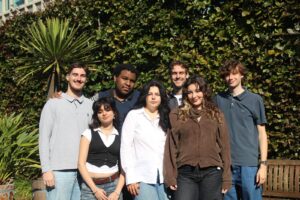
With VSP staying away from the elections, Westhoff does expect a less “hostile atmosphere”. He describes relations with ConsensusVU and VU Student Coalition as friendly. At the same time, he thinks it’s a shame that the voice of more conservative or religious students disappears from the council as a result. “There should be room for that voice on campus. But maybe this is an opportunity to bring the attention back to the local issues it should be about: alternative exam venues, canteen prices. Not rainbow flags and the Pride Library.”
One of the first things the party wants to tackle is the underuse of space at VU – citing as an example a former study area on the second floor of the main building that has been converted into an exam hall and therefore stands empty “98 percent of the time”. “I really find it unacceptable that there is so little space at the university that is being underused.”
Another concern is what Westhoff calls ‘securitisation’. According to him, there is less and less room for students to organise themselves organically, in a “horizontal way”, through initiatives and protests. “Student and Educational Affairs has taken over the management of the Studentendok from the student union, for example, and there is more and more security present at VU. Social safety is also very important – but I do have the feeling that students are being viewed with more and more suspicion. Activism and extremism should not be seen as the same thing.”
On the other points they want to champion – student wellbeing, accessibility, safety – there seems to be overlap with the other two parties. Will ChangeVU’s take on them look any different? “Not necessarily. What ConsensusVU stands for isn’t entirely clear to me yet. But I think we agree with VU Student Coalition on 99 percent of things.” So is there less at stake? “You still want to win as a party, but it’s a plus for everyone that there are no far-right people on the list. Still, we have to remain vigilant.”
ChangeVU is looking forward to working with both parties – this year for the first time as the oldest party in the elections. “Maybe we should change our name to EstablishmentVU,” Westhoff laughs. Whether their previous experience can be an advantage in the elections is hard to say, he thinks. “We’ve become good at creative campaigning and we have people who know how student elections work. But people also often enjoy voting for something new.”
Vrijmoedige Studentenpartij
VSP is not taking part in this year’s elections, citing a climate of ‘intimidation, threats, demonisation and organised obstruction’. Asked whether they would have been allowed to run if they had wanted to, a VU spokesperson says that any student enrolled at VU who pays tuition fees and appears in the electoral register as of the reference date of 1 February can stand as a candidate for the USC.