


European researchers can apply to the European Research Council (ERC) for research grants. Competition is intense, yet over the past two decades the Netherlands has secured nearly ten percent of the total funding awarded – around €3 billion euros.
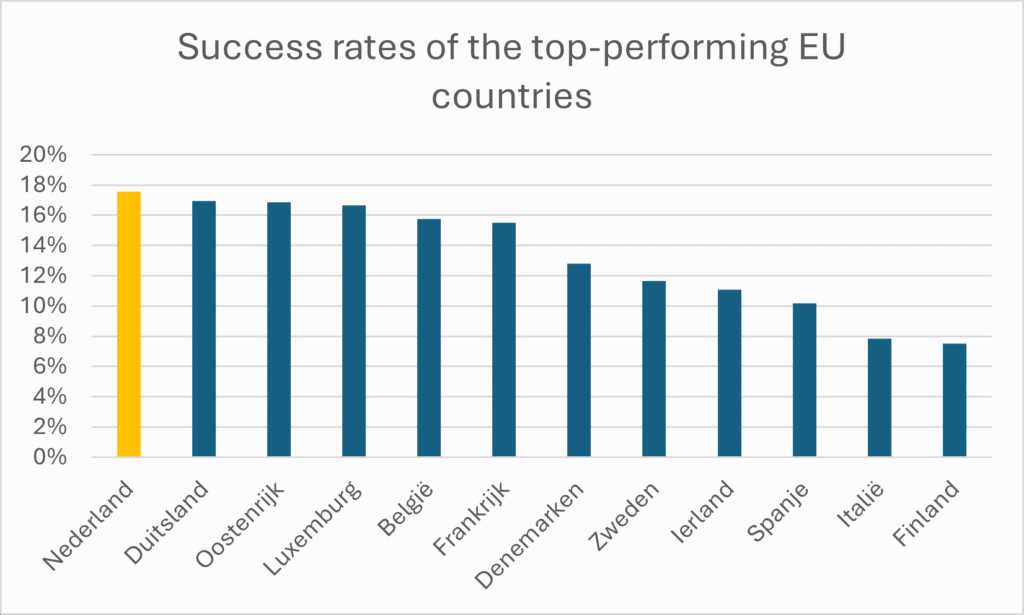
Almost eighteen percent of the Netherlands’ applications are approved, the highest figure among EU member states. A successful application can earn an individual researcher between 1.5 and 2.5 million euros in funding.
However, not all countries are equally successful. Countries in Central and Eastern Europe in particular secure relatively few grants. This creates a vicious circle, with successful countries accumulating experience and continuing to attract funding, while others struggle to break in.
A missed opportunity, says Polish scientist Leszek Kaczmarek, chair of the ERC working group that promotes broader European participation. “We’re losing an enormous amount of talent”, he explains in a phone interview. “This means Europe as a whole misses out on discoveries, insights and technologies.”
Large disparities
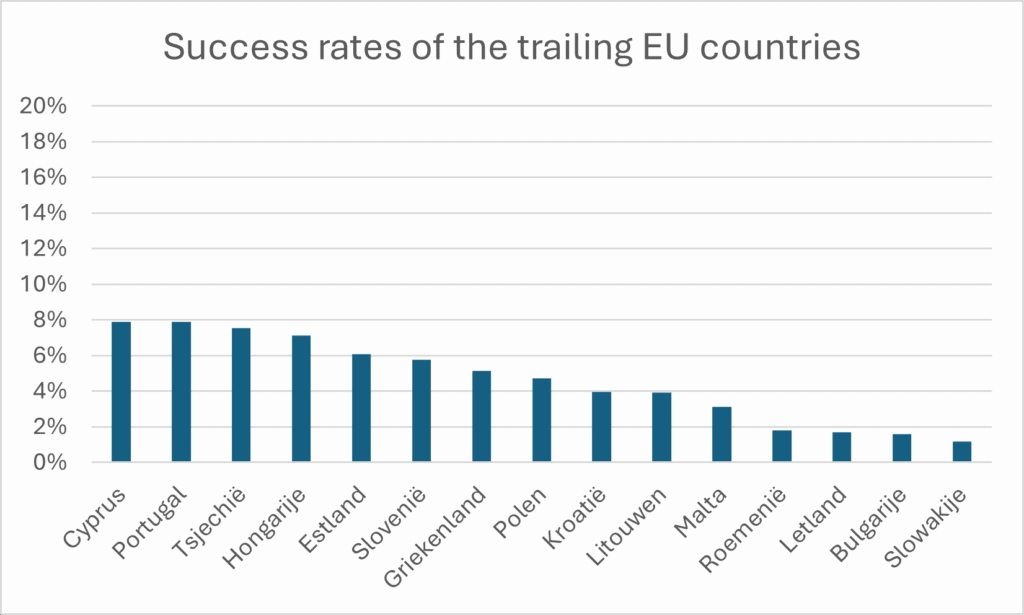
The trailing group comprises fifteen EU countries. Together, they represent about a quarter of the EU population. These countries have made modest gains, the ERC reports in a new study, though they continue to lag behind the rest.
In countries such as Greece, the Czech Republic and Poland the situation has improved. In recent years, the success rate in these three countries has been between eight and ten percent. Between 2007 and 2011, this was three percent or less, according to ERC figures going back to 2007.
Even so, these fifteen countries continue to secure relatively few grants. Over the past five years, the Netherlands pulled in twice as many as all of them combined. “It’s encouraging that success rates are increasing, but the number of applications remains low”, says Kaczmarek. “Many researchers in these countries don’t even bother to apply, convinced their chances are slim.”
Research climate
According to the ERC report, the low success rates are mainly due to the research climate: these countries simply offer fewer opportunities for scientists. They receive limited support when preparing grant applications and have fewer international connections to draw on.
Change must therefore primarily come from within the countries themselves, the ERC argues. According to Kaczmarek, the ERC’s greatest strength lies in its soft power: “The ERC can help countries strengthen their academic culture and expand opportunities for top scientific talent.” That, he says, will have greater impact than measures and programmes alone.
Still, some support can help. In 2016, the Research Council launched an exchange programme allowing scientists from Poland or Hungary, for example, to spend a few months working with research teams in countries such as France, Germany or the Netherlands.
The ERC also introduced a mentoring programme in 2021, through which successful researchers offer advice and training in preparing grant applications. And in 2025, the ERC invested 1.5 million euros in strengthening national contact points, enabling researchers to receive guidance and support in their own countries.
‘Postcode bias’
Kaczmarek also warns of possible ‘postcode bias’: where you come from may influence your chances of obtaining a grant. This may influence reviewers unconsciously, underlining the need to make them aware of this risk.
Kaczmarek compares it to gender inequality in research. “For years, women were much less successful in applying for research grants”, he says. “Things began to improve only after the scientific community acknowledged the issue and recognised the role of unconscious bias in grant decisions.”
“That’s not only unethical, but also a tremendous shame”, he adds. “We wasted talent by not giving women the opportunity to fulfil their full potential. The same now applies to researchers from these fifteen countries.”
Happy islands
The ERC hopes that more ‘happy islands’, where the success of a few researchers inspires others to try their luck, will eventually emerge in the trailing countries. It’s important to support these islands, says Kaczmarek: “Talent must be nurtured.”