
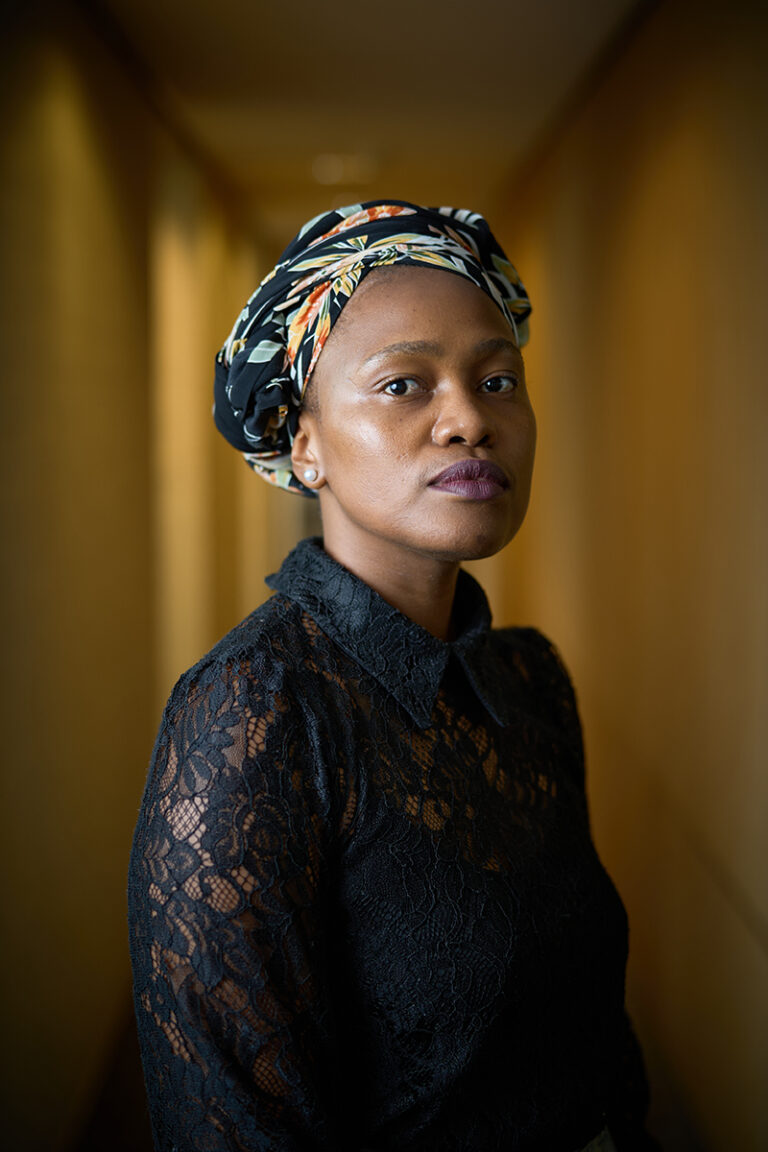
Your PhD–thesis is on the experiences of black women in academia. In a way you were your own subject of study, right? “When I interviewed other female black PhD-students, their experiences were very similar to mine and it felt cold to me to stay completely detached the way I am trained as a scientist. It just didn’t feel natural to me.
“There was a shift when I realized I had to leave too much of myself at home. The Euro-patriarchal system is strong in academia, but if we want our universities to really open up to people of different backgrounds, we must consider other ways of approaching science and knowledge.”
Abongile Sonkosi (37)
2021-now Joint PhD at VU and Rhodes University (South Africa)
2018-2021 Lecturer, Walter Sisulu University
2015-2018 Master’s Rural Development, University of Fort Hare, South Africa
2010-2012 Bachelor’s Social Sciences, University of Fort Hare, South Africa
Can you give us an example where your situation didn’t match the expectations we have of PhD-students? “The standard PhD-candidate comes from a middle class background; he is young, and doesn’t have children or financial responsibilities for others. I was working on a scholarship, I have a family, and I am the mother of an eight-year-old daughter. For me, going to conferences was a financial and emotional stretch. I relied on my supervisor’s support to cover hotels and travel costs.
“And then, living and working in Amsterdam meant I wouldn’t see my daughter for 4 months over multiple stays. This was a big sacrifice. Despite the warm welcome I got from my supervisors Henk van den Heuvel and Christine Teelken and the steady support from my South African supervisor Sioux McKenna, I felt sad and lonesome during my first weeks in Amsterdam. I didn’t feel I belonged to the VU community, partly because of cultural differences.”
Enriching science
Sonkosi’s writing about her personal journey during the PhD-trajectory is fresh and deeply moving. If decolonising science means giving space to voices as hers, the result is an enrichment of the whole scientific community. Read Sonkosi’s thesis: tinyurl.com/sonkosiphd
How did you experience these cultural differences? “In South Africa, you will greet your colleagues and make small talk, just to acknowledge the relationship and acknowledge each other as a person: I see you, you see me, we’re both human, that gives us a connection. At VU there were people I knew who just walked by me without greeting. I knew I shouldn’t take it personally, but I had a hard time with that.”
Did you find your network in the end? “Yes, at Uilenstede – where I lived – I met other students with an African background. And I found friends amongst the women I interviewed. We supported each other, and some of them will be friends for life.”
What did you miss being a PhD-student at VU? “We say we want our universities to open up to all kinds of people, but we do not support them with what they need as human beings. At Rhodes University, our group of PhD-students and supervisors would meet every two weeks in a social non-structured setting, where students would have the opportunity to discuss things with others, or with supervisors other than their own. I really missed such a thing at VU.”
And in research? “I discovered the western rational approach is too narrow for me. It felt like an act of decolonisation to write about my own struggles and my emotional journey during my PhD. We are so much more than rational beings, we have so much more and deeper knowledge.”
You write about ancestors also. What is their role in your life? “In Xhosa culture, ancestors are very important. I feel supported by them. My brother died in an accident in 2024, that was the hardest time for me. He was always telling me how proud he was of me. Now I can sense his presence at important moments, like my PhD-defense.
“Also in my research, during or after the interviews, I would sense the ancestors of the person I interviewed. This made the information more complete.”