


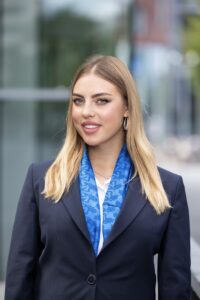
Science has always been my way of understanding the world. Since I was little, I’ve always wanted to know why things work the way they do. Not just in theory, but also in ways that could actually help people. That curiosity is what pushed me to leave Croatia and go study abroad. After completing my BSc in Biomedical Sciences at VU, I’m now pursuing a Master’s in Oncology, the study of cancer, a field that challenges me every day with its complexity.
In research, every discovery is a product of teamwork, critical thinking, and the freedom to explore new ideas. You learn quickly that when questions stop, progress stops, and I believe the same goes for how we teach and learn.
Oncology constantly reminds me that science isn’t abstract; it’s deeply human. Behind every cell sample, there is a person with a story, a family, with struggles and aspirations. That perspective shapes how I approach everything I do outside the lab, especially in the University Student Council. As the Coordinator of Education and Research, I often deal with policies, procedures, and frameworks. But I try to look at them the way I look at research, by asking what impact they have on the students, which I’m meant to represent.
And I think that’s what makes my perspective so different. In science, you’re trained to listen to data, but also to doubt your assumptions. You learn that collaboration beats competition, that progress comes from sharing knowledge, and that ethical decisions matter just as much as technical ones. I aspire to bring that same mindset to the council work: evidence-based but empathetic, analytical but still human.
For me, education should feel alive: connected to the world around us, driven by curiosity, and open to every perspective. The VU shouldn’t be a place where people think they have all the answers, but a place where we can admit we do not know everything and instead find out the right questions to ask. We are all connected, and only through working together can we find those answers, whether it is in oncology or in the University Student Council, because that’s how real change actually happens.