
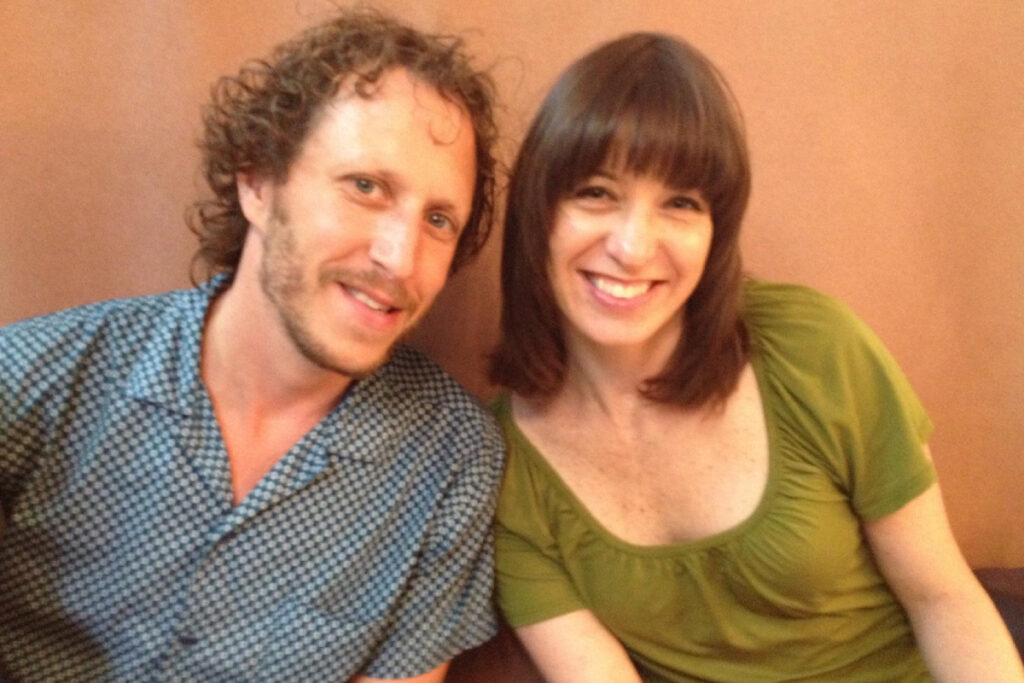

Comedian Ophira Eisenberg’s mother was 14 years old when Nijmegen was liberated. She fell head over heels for an Allied soldier with whom she left for Canada. At a late age, she had Ophira, who earns her living as a comedian in New York.
Ophira (Calgary, 1972) and I met for the first time in 2007 during the Edinburgh Comedy Festival. I was immediately charmed by her sleek, funny, and very personal style of comedy. Although her stage persona is much more cheerful than mine, I have always perceived her as a kindred spirit.
When I learned she was closely connected to ‘The Moth‘ , the now-famous storytelling podcast that inspired Paulien Cornelisse and me to start its Dutch equivalent, Echt Gebeurd, we invited her to Amsterdam to teach us the tricks of the trade. Since then, we have stayed in touch. Over the years, she has told me a great deal about how to structure stories, present a show, and relate to the audience. Her insight, honed from years of performing in New York’s top comedy clubs, has definitely informed how I approach my trade.
This week, she is coming to Holland with her one-woman show ‘Leaving a Mark’ that examines both her Dutch roots and the stories connected to the scars we all carry on our bodies. A good opportunity to catch up and ask her some questions:
You started out in comedy a long time ago. When did you realise you were funny?
“I wasn’t a huge stand-up comedy fan before I started doing it. When I was a teenager, I’d listened to a few comedy albums, including Bill Cosby, Woody Allen, and Steve Martin, but I didn’t picture myself in that role. But my family was very funny, and I often take it back to this moment: My mother had thrown a big dinner party for the family. I’m the youngest of six, so there were 14 of us sitting around the table, and everyone was telling jokes. I was about 11 years old, and I’d heard a joke at school about religion. Although I was nervous, I decided to finally try to engage and tell this joke to the family. I found my moment at the table and retold that joke, and it got a big laugh! I remember my dad laughing, and that meant a lot to me. For the first time in my family, I took up space. I wasn’t the baby; I was one of them. That memory really sticks with me, although I didn’t even try stand-up comedy until I had finished my B.A. at University in Cultural Anthropology, which perhaps is a joke in itself.”
When did you hear about storytelling, and what drew you to it?
“In my 20s, I saw Lily Tomlin’s “The Search for Signs of Intelligent Life in the Universe” in the movie theatre, and it really struck me. I started writing down personal stories of my own, really unsure of what I would do with them as they didn’t fit into a stand-up act.
Then I moved to New York, and a friend invited me to go check out this cool live storytelling show called The Moth. It wasn’t a podcast then, but it was wildly popular. This was shorter-form storytelling; the people on stage had 5 or 10 minutes, and the audience was full of artsy types: writers, actors, painters. I felt like this was my home, and it inspired and gave me the courage to try to start telling my own stuff.”
Paulien Cornelisse, with whom I started Echt Gebeurd, always says that storytelling with Echt Gebeurd is more welcoming to performers who are not white cis gender males. Is that something you relate to?
“Yes! Although I find storytelling more equitable than stand-up usually. I know every single one of us is filled with loads of interesting stories from our lives, but many of us are missing the authority, even permission, to believe that we should be telling them. I think the average white cis guy inherently believes his stories should be heard, but we need to empower everyone else to feel the same.”
In your one-woman show, you talk about scars. How did you come up with that topic?
“Luckily/unluckily, I am covered in scars! Because I’ve lived with many of them most of my life, they have really influenced how I see my body, my sense of beauty, and mortality. When I first started working on parts of this show, I found that so many of us are walking around with scars with vivid memories attached – and they can be the big, huge life-altering ones, but also smaller situations that affected us – like a childhood playground accident, or even something dumb or dangerous you did as an adult. Also, as it stands right now, there is no technology, cream, or laser that actually gets rid of them. So I became very interested in looking at my own sense of identity through the lens of these marks on my body that are with me forever.”
You have travelled all over the US with your show. What has talking about scars with the audience told you about them?
“The audience interaction might be my favourite part. It’s incredible to find out what people have endured! And we’re all just walking around like nothing happened to us. I see my audience so differently once they tell me about a wild surgery they had to go through, or an animal attack, or an accident they got into with a machine. My favourite one to date was in Bozeman, Montana, at the historic Ellen Theatre. I had heard a couple of great stories from the audience, but the crowd was shouting that someone in the back had a good one. I couldn’t see the back of the theatre, but it seemed like someone was holding up an umbrella in the air. So I asked, ‘Is that an umbrella you’re holding up?’ And the crowd around them shouted, ‘It’s her leg!'”
In your show, you mention how your mother left Nijmegen after the liberation when she was 16 to be with your father, who was an Allied soldier. What would she tell you about the country she left behind?
“My mother raised me to believe that everything in Holland was better. Ha! She did not have pleasant memories of living there as a teenager during the war, but she loved going back to visit her family when she could, and felt that Holland was more advanced in every way. My childhood in Canada was full of muisjes, haring, and Hema tea towels. She also used to sew all of my clothes as a child and tell me that the fashion there was seven years ahead. She had a ton of Dutch pride.”
At the moment, the US seems about seven years ahead of us. What is it like to do comedy in New York in these disconcerting times?
“Focusing on the positive, it really has impacted comedy in a couple of great ways. First is that many people come up to you afterwards and say, “You know, we really needed this. We needed to laugh and just have a great time for a couple of hours.” So that speaks to the escapism that comedy can provide an audience. But also, a ton of comedians have been inspired to write and perform sharp, political jokes and political satire, and there is a ton of relief in that after a day of doomscrolling and feeling powerless. You forget how much audiences need to hear different perspectives, and they actually appreciate it so much.”
Ophira Eisenberg performs her English-language one-woman show, Leaving a Mark, on April 28 at De Landing in Amstelveen, April 29 in Amsterdam,, May 1 in Groningen, May 4 in Diligentia Den Haag, and May 5 in Nijmegen, the city where her story began.