

In her lecture, Reventlow reflected on the meaning of heroism and radical justice. For although heroes can play a guiding role for those inspired by change, they can distract from an individual’s own role in working towards justice.
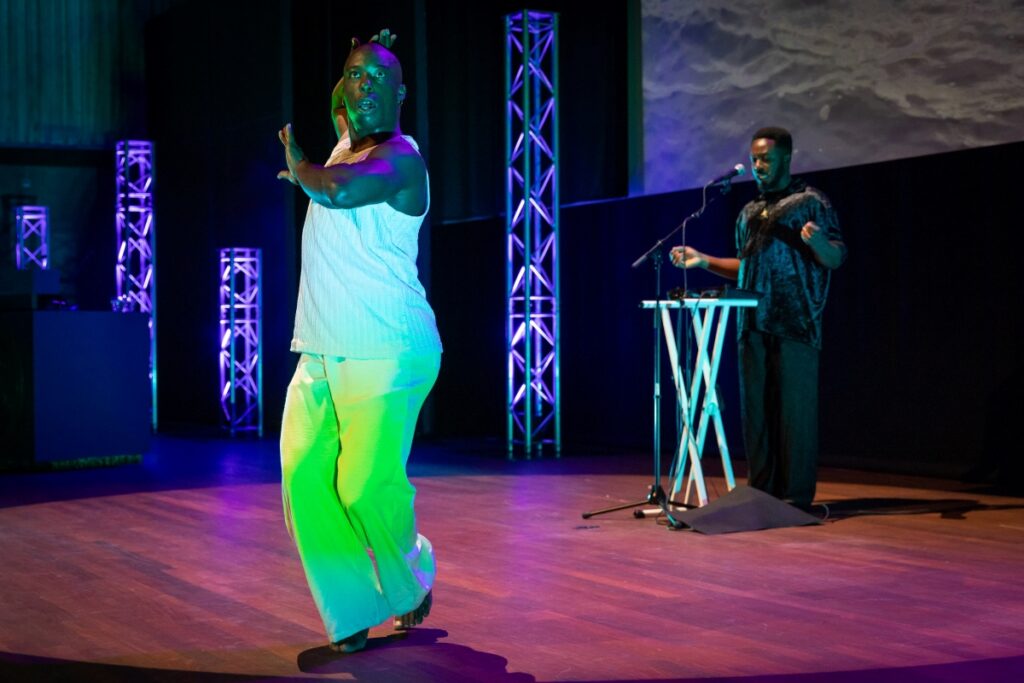
The lecture took place in the aula and was co-organised by the VUvereniging and the Anton de Kom chair. It featured speakers, a spoken word competition, and a dance performance by Jordan Achiano, accompanied by singer OTION, all exploring this year’s main theme: radical justice. And with a slightly delayed start, and a quick-witted quip, “For radical justice, there is always time!”, the lecture began.
Root of the problem
Tanja Jadnanansing, chair of the executive board of the Amsterdam-Zuidoost district and moderator, spoke with Margrethe Jonkman, chair of the executive board of VU; Nieke Elbers, associate professor at VU and senior researcher at the NSCR; and Dave Ensberg-Kleijkers, chair of the Martin Luther King Foundation. “Radicalism is uncomfortable for some, but it is needed. It simply means to go from the root of the problem,” Elbers said.
In the audience, student Michael Weiler feels seen by this sentiment. He views himself as a “very radical person” and believes that “when we talk about justice and not in a radical sense, it misses the point”. Addressing the root causes of injustices today, namely “colonialism and white supremacy”, is therefore the “most important way to achieve justice”.
The three spoken word artists, Lorraine Siwabessy, Caitlin Shawn, and Thabang Mnculwane, explored their own relationships with radical justice. Particularly Mnculwane articulated the strife for justice well, describing it as the refusal of “the powerful building walls, while the silenced are digging graves”. With this imagery, he walked away with first place and 500 euros.
‘No movement is perfect’
Reventlow spoke about the need to view social movements with honesty and nuance. “No movement is perfect, and it doesn’t have to be,” she said. “The American Civil Rights Movement was revolutionary, but it also sidelined many women. We must learn to sit with that complexity and discomfort.” She argued that change doesn’t come from perfectionism; it comes from persistence; “from learning, unlearning, and reflecting within a moving landscape.”
She urged the audience to move away from hero worship and towards collective courage, as relying on heroes may minimise our own agency and feelings of accountability. Moreover, the stereotypically male-dominated saviour characterisation of heroes excludes all those other activists who look a bit different. Instead, Reventlow hopes to inspire everyone to use their own strengths to fight for social justice, recognising the activist within all of us.
Quoting civil rights leader John Lewis, she spoke of the need to make “good trouble.” Activism, she reminded the audience, isn’t only for those who choose it. “Most people on the front lines are resisting out of necessity.” But we all bear responsibility to act, she said, and to make a “tapestry of sustained activism to make deep, lasting change.”
Finding balance
According to Elbers, this lasting change is also the result of focusing on restorative justice. This form of justice is a way to deal with harm and conflict by repairing relationships, not just punishing. “Punishment doesn’t address the root causes.” Indeed, to build a safer and more resilient society, Elbers encouraged the audience to work towards a culture change of restorative justice, to respond to harm and prevent conflict through inclusive and systemic communication.
VU alumnus Ed (who preferred to omit his last name) identifies more with Elbers’ conclusion. He is somewhat sceptical of the value of radicalism. “You can only work together with people who listen, are flexible, and want to solve a problem.” Being radical undermines solving problems pragmatically, he fears. Instead, “radical ideas lead to war”.
Radical justice
For anyone interested in learning more about how justice can contribute to structural change and social equality, Reventlow’s newest book, Radical Justice, offers more insights. Copies were selling fast after the lecture, outside of the aula.