
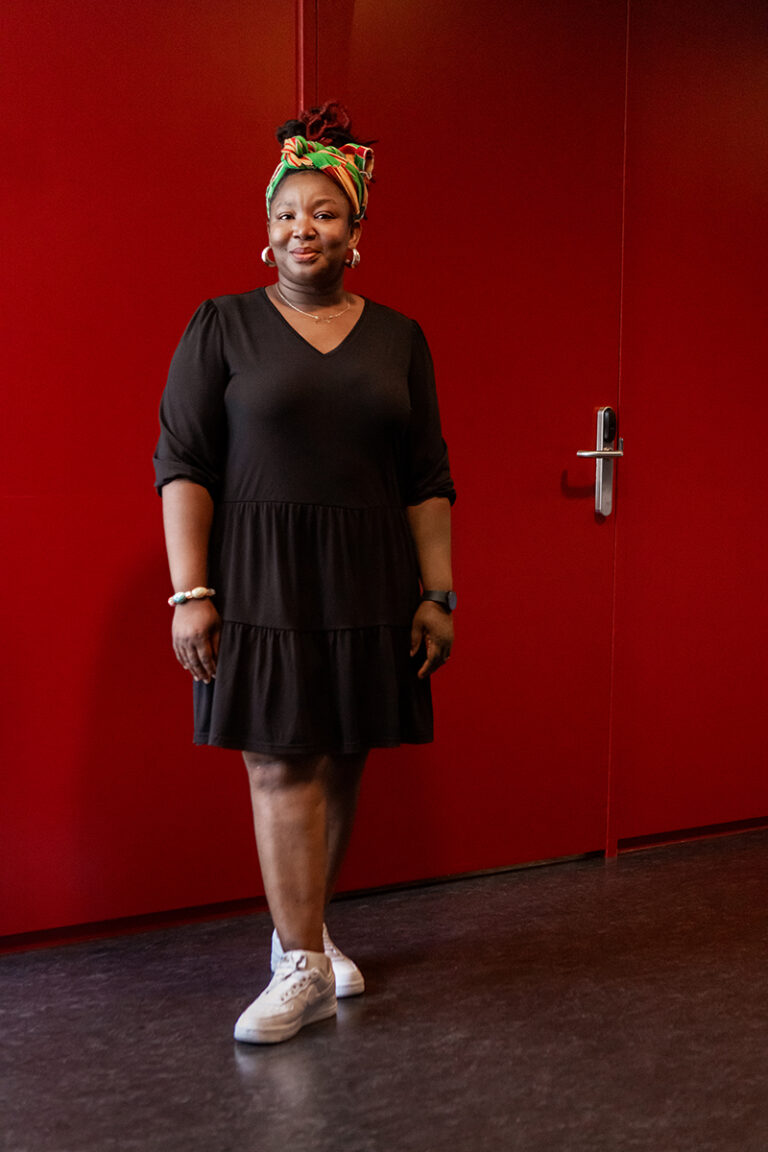
“Things don’t easily break me”, Bakuri says. She has learned to be careful where she puts her energy. Being a Black woman in a predominantly white and male academic world, she has experienced forms of racism and prejudice more than once. She hesitates to share them, since she doesn’t want to give them weight, but then she shares a few examples:
“Are you coming to clean my office?”, a fellow scientist asked her at the university where she worked at the time. At a conference where she presented her research, another academic asked whether she was defending her people.
Amisah Bakuri
- Bachelor’s History and Political Science in Ghana
- Moved to Groningen for her master’s
- Returned to Ghana for a teaching job
- PhD in Anthropology and moving between countries before settling down in the Netherlands as assistant professor
Bakuri doesn’t let these experiences define her life. “If you don’t see me as a person, I don’t waste my time and energy on you”, she says. She focuses on safeguarding her peace and joy. “I’ve always been joyful”, she says. “It’s part of my character.” Bakuri was born in Damongo in Ghana’s Savannah Region and grew up in Sunyani in the Bono Region. Her mother, now retired, was a midwife. Her father, a budget analyst, died in 2001 when Bakuri was still young.
“My childhood was happy”, she remembers. “I grew up surrounded by love.”
Lasting relationships
She did a bachelor’s in History and Political Science in Kumasi, Ghana’s second-largest city. There, she also met her future husband. After graduating, she stayed on as a teaching assistant at her university. She then moved to Groningen, the Netherlands, to pursue a Research Master’s in Modern History and International Relations. It was the beginning of a life that would be defined by mobilities. After completing her master’s degree, Bakuri returned to Ghana, got married and became an assistant lecturer at a university in Kumasi. In January 2016, she moved back to the Netherlands to start a PhD in Anthropology at the University of Amsterdam.
Her research explored how religion, sexuality and well-being intersect in the lives of Ghanaian-Dutch and Somali-Dutch communities. “There is still a tension between people with African roots coming from colonies like Suriname and people coming from Africa directly. Some Surinamese consider people from West Africa as traitors, since the ancestors of the Ghanaians sold Surinamese ancestors as slaves to the Dutch. In some church communities this division runs deep, and it plays out in how people approach each other”, Bakuri explains.
Her fieldwork led to lasting relationships with research participants and some amazing colleagues. “I’ve known some of my participants for more than ten years”, she says. “I’ve seen their children grow up.”
Temporary homes
After completing her doctorate, Bakuri worked as a teacher at University College Utrecht and Utrecht University. She then took up a postdoctoral fellowship at the University of Toronto, where she helped develop a course on Black health for medical students and healthcare professionals. Her husband and children remained in the Netherlands while she travelled back and forth between the two countries. “It was emotionally exhausting”, she says. “Financially exhausting too. Living in two countries isn’t sustainable.” But she had a supportive family and community.
Bakuri was happy when she got appointed as assistant professor of ‘Lived Religion and Society’ at VU. Her husband currently works as a microbiologist at Amsterdam UMC. For years, they lived in temporary homes in and around Amsterdam. Their eldest son wrote poems and stories about having moved so many times.
At some point they decided the kids needed a stable home and it was time to find a more permanent place to live. “So they wouldn’t have to change schools or make new friends every time”, Bakuri says. Three years ago, they found a place in Lelystad.
Ghanaian singing
In her personal life, Bakuri has found her community at a Pentecostal church in Amsterdam-West. Finding a church community was important to her as a Christian: “I was raised as a Catholic, but we didn’t feel welcome in a Catholic church in Amsterdam-West. Then one day, while walking through our neighbourhood, we heard Ghanaian gospel music coming from a nearby building. We looked at each other and said: Let’s find out what’s going on there. We entered a church and were welcomed with open arms. This community has become our family abroad”, she says.
After years of moving between countries, universities and temporary homes, Bakuri now carefully chooses where to invest her time and emotional energy. She keeps her world intentionally small. It centres on her family, including her husband, three children, her mother, close (extended) family, colleagues, friends and church members. Bakuri is happy in her ‘small circle’.
Dr Ami is indeed a very happy person even if you follow her from afar, you can attest to that.
I am happy to have come across her on social media. I really look forward to meeting her soon.
She’s got such lovely vibe.
I enjoyed reading this.
Lots of love from London
Royal Nana Ama