

The track was taken offline on Wednesday, but before that, an AI-generated indictment against asylum seeker centres was on its way to becoming number 1 in the top 50 most-streamed songs on Spotify in the Netherlands. We’re not going to let that happen, thought UvA student Olivia Jaeggi. She drafted a message to send around, in which people were called upon to stream another song so often that it would reach number 1 instead of Wij zeggen nee nee nee tegen een azc [translation: we say no, no, no to an asylum centre].
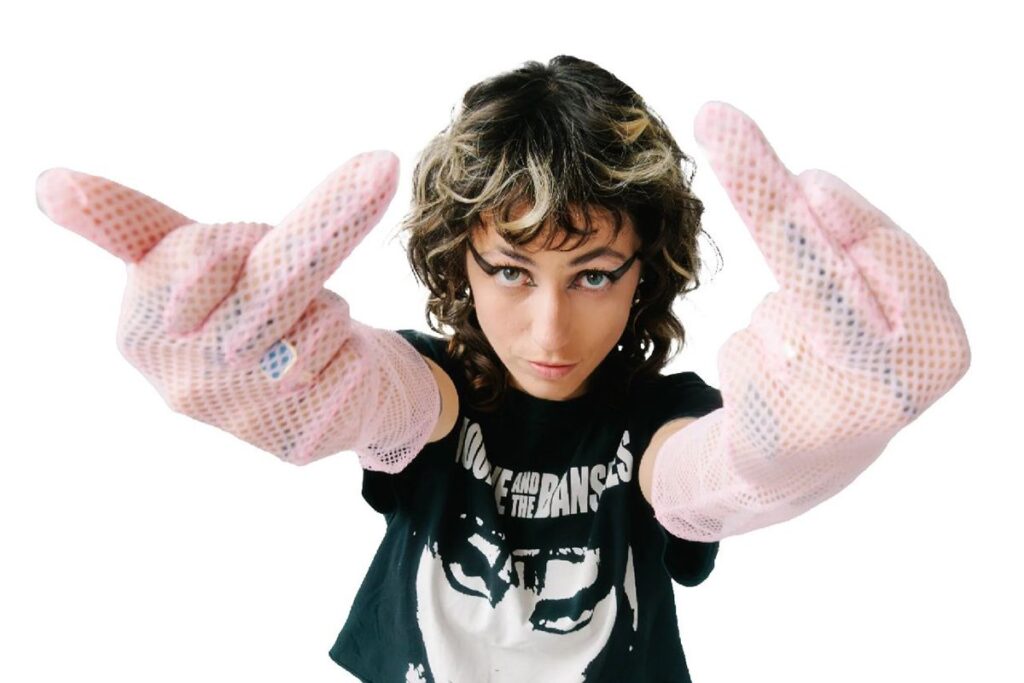
Only they were still looking for a good replacement. “Taylor Swift was number 1 on the list, but I didn’t see the point in having everyone massively stream the most-listened-to artist even more. I wanted to give it an activist edge,” says Jaeggi. That’s where VU student and student reporter for Ad Valvas Isa Boere got involved. She saw the matter pass by in her theatre association’s group chat, with the question of which song would be suitable for the counter-action. Boere: “I immediately thought of Sophie Straat. In Vrijheid, Gelijkheid, Zusterschap [translation: Freedom, Equality, Sisterhood] she sings: ‘The AZCs are long gone.’ As in: they’re not even up for debate anymore.”
Endlessly on repeat
From there, the message spread like wildfire across the internet. People forwarded it to their entire contact list, activist groups including the Dolle Mina’s reposted it on social media, and Sophie Straat shared it in her own Instagram story. This past Tuesday it became the most-streamed song on Spotify Netherlands. In the end, there turned out to be some technicalities around which streams actually counted. Some people streamed the song muted for hours on end, or had it endlessly on repeat, until it became clear that it only counted as a stream with the sound on and alternated with other tracks.
On Wednesday the anti asylum centre song suddenly turned out to have been removed from Spotify and YouTube. The initiator of the AI track ‘JW Broken Veteran’ says he did not take it down himself, and that he is doing everything he can to get it back online as soon as possible. He suspects he has been hacked. In a statement on his YouTube account he already said a week ago that he would stop making protest music, due to the many threats he had received.
“But I wouldn’t call that AI track a protest song,” says Jaeggi. “Protest music may be angry, but works better if it also calls for connection. I think that’s why Sophie Straat was such a good counter-voice, and why she got so many people behind her.” Boere also struggled with how the two songs were played off against each other in the media. “It was made into a political battle: left versus right”, she says. “Whereas it’s really a matter of humanity,” Jaeggi adds. “It’s not left or right to think that people should be received with a loving sentiment instead of with a hateful rotten song. Reaching out to someone who has it harder than you, instead of slapping them in the face, is something many people can identify with.”
Symbolic politics
Still, their action also received criticism, and Sophie Straat reportedly got a lot of “crap” thrown her way. Critics felt it was market manipulation to gain streams in this manner. Sophie Straat, in turn, writes on Instagram that she is donating the proceeds from the streams to the organisation MiGreat, which advocates for a humane migration policy.
Jaeggi also read comments from people saying it was purely symbolic politics, and that if they thought it was all so terrible, they should go to asylum centres themselves to help there. “My reply to that is that we shouldn’t underestimate the power of symbols. Music can unite us. There is a rich history of music that had meaning in situations of injustice: think of the blues that emerged on plantations from oppressed black people singing through their pain, or the extremely political punk movement.”
The action does not only leave symbolic traces. The number of volunteer applications at the Dutch Council for Refugees has risen since the reporting on the anti asylum centre track. The foundation also created an AI song of its own on Tuesday as a response: Ja, ja, ja, zo is Nederland [translation: Yes, yes, yes, that’s how the Netherlands is]. Jaeggi and Boere think their action was successful because it had such a low threshold. Boere: “I actually haven’t been involved in activism before, but this was something you could also just do anonymously. I’ve now immediately joined the Dolle Mina’s.” Jaeggi: “That’s actually the coolest part for me. People came together to speak out against the song, but also against the sentiment it represents.”