
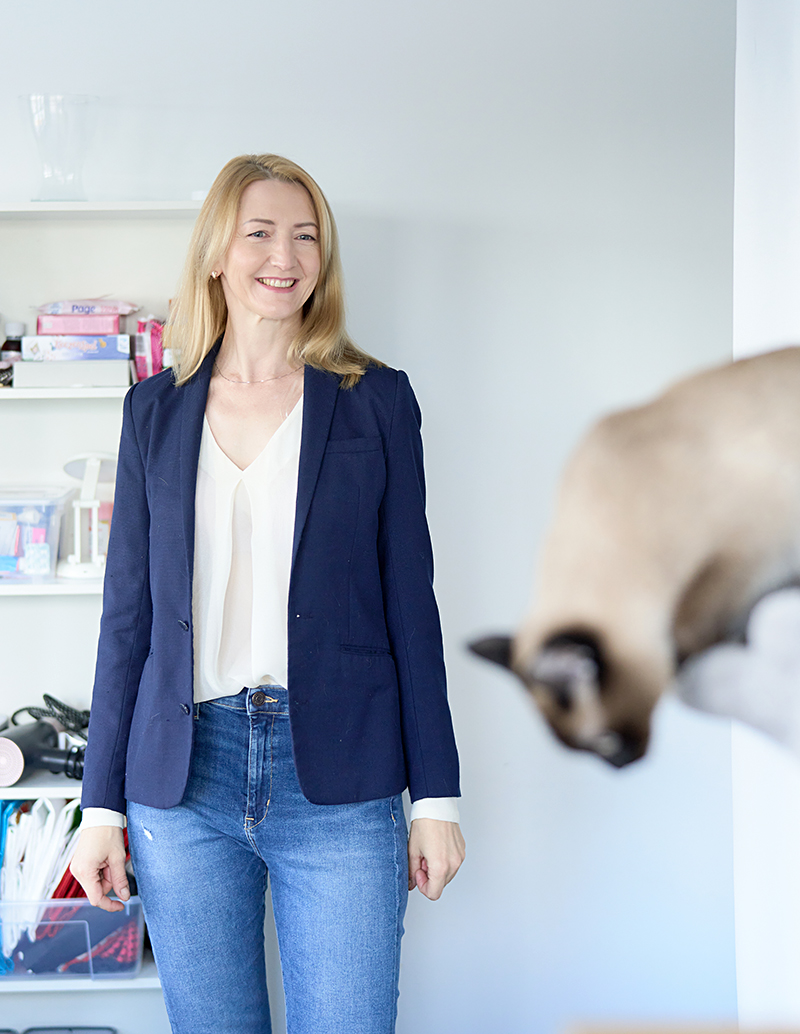

Nataliia Krysanova (48) had just finished the first year of a PhD programme in Economics when the war started in her home country. She fled to the Netherlands with her eleven-year-old son and wanted to start studying immediately – also to take her mind off the war, she says. Now, the Ukrainian refugee student is studying Business Analytics, hoping she can still make a career in the Netherlands. “I’m aiming for a position as a business analyst, possibly in a bank, where I can combine my banking experience with my freshly obtained analytical and programming skills”, she says. She hopes to become financially independent and be able to afford her own apartment.
When she started her study, she worried about “being much older”, surrounded, as she says, by students in their twenties or even younger. “But they don’t give me the feeling of being older. Sometimes there were students who thought I was a teacher when I entered the room. But when I’m working with them on a project or a group assignment, they treat me as a peer, as one of their own.”
Before fleeing Ukraine, she worked for the plastic card department of a bank in Dnipro, where she lived, and was responsible for the development of payment cards and services.
Escape from Ukraine
The war started with a Russian invasion across multiple regions, targeting Kyiv and other major cities. “In Dnipro, we were not under attack yet, but the first days were terrifying”, Krysanova says. “I had no idea what it was like to be in a war. I imagined soldiers would enter our house and threaten us or worse. But it wasn’t like that. There were air raid sirens, local military preparing defenses, constant news updates, and this dread of what was about to come. We mostly stayed and slept in the basement because of the alarms. It was very scary.”
After hearing the news about a heavy attack on Kharkiv’s Freedom Square, around the regional administration building, where around thirty people died, she was determined to take her son and try to reach the border by train. “I had no tickets; it was impossible to buy them. We just went to the station and were shocked by the huge crowds of people trying to leave. The train doors were closed, and people were knocking on the windows, asking to let women with children in. Eventually, a train worker opened the door, and I don’t even remember how we got inside, the crowd carried us in. I held my son’s hand tightly, trying not to lose him. A sleeping wagon built for 50 people had easily 250 inside. It was hard to move, let alone go to the toilet.”
The lights of the train were extinguished to avoid becoming a target for Russian fighter jets. “We moved forward in complete darkness, sharing medicines and water with each other. It was terrifying. We weren’t even allowed to text friends or family because of the lights from our phones, so we covered ourselves with our coats to send messages.”
Holiday on Ice
Upon arriving in Lviv, they were relieved to get off the train after 23 hours of travel and overwhelmed by the number of volunteers that handed out food, coffee, and tea. They reached the border at night and after waiting in line for about four hours, they finally crossed into safe territory. From there, they changed trains to Bratislava, then Prague, and Berlin. At every station, volunteers offered food and a place to stay, “but we kept moving on, further and further from the war”, Nataliia says.
When they arrived at Amsterdam Central Station, nobody was there to meet them – they were among the first to make it so far from Ukraine. “We asked two policemen for help”, Krysanova says, showing a photo on her phone of her and her son posing with a smiling policewoman. “We were accommodated in the Savoy Hotel. It was such a relief. We were tired, but finally safe.”
The stories of Ukrainian refugees are somewhat different from those of refugees from countries like Syria or Eritrea. Krysanova and her son were treated as guests, taken to museums and concerts. “They gave us tickets to Holiday on Ice.”
After she settled in, her sister arrived with her children. “While my son hadn’t experienced the sounds of bomb attacks because we left Ukraine earlier, my six-year-old niece was initially triggered by the noise of fireworks and planes overhead”, Nataliia says. Later, her 26-year-old daughter also came to Amsterdam, bringing along two cats. They are all living with other Ukrainians in a kind of dorm in Duivendrecht, each in a small but private room. They’re learning Dutch, and the children study and enjoy swimming lessons.
Listening to Dutch while biking
Krysanova couldn’t work at a bank because her Dutch wasn’t at the required level, so she took a job on a computer factory’s assembly line. “After two months, I realised it wasn’t what I really wanted. I wasn’t happy or satisfied”, she says.
Determined to pursue a meaningful career while learning Dutch, she enrolled in Applied Mathematics at Inholland University of Applied Sciences, the only Amsterdam university at the time offering reduced tuition fees for Ukrainians under the EU Temporary Protection Directive. She quickly found her footing and improved her English.
Hearing that the University Assistance Fund (UAF) supports only a small number of Ukrainians in pursuing their studies and starting careers, she applied. She expected rejection because of her age, “but I was motivated and had a clear career path, so they accepted me”, she recalls. She earned her first-year certificate at Inholland and then continued at VU. This year, she plans to complete her Bachelor’s in Business Analytics. “I am also considering pursuing a Master’s in Computational Science in parallel”, she adds, aiming to advance further in her field.
It shows just how determined she is. She has gone to great lengths to learn Dutch. She can speak it, but she doesn’t yet feel confident enough to do a job interview in Dutch. She started with a course for refugees offered by her municipality, earning her an A2 certificate, and then continued studying Dutch at VU. “It’s hard to balance learning Dutch with my studies, so now I improve my Dutch by listening to recorded speech while biking to and from the university”, she explains.
Celebrating King’s Day
Her son, however, speaks it like a native, she says. “I realised when we were at McDonald’s the other day, how proficient he was ordering at the counter. When we arrived in the Netherlands, he spoke neither English nor Dutch.”
It took him a while to get used to his new surroundings. In primary school, there were Ukrainian teachers who supported the Ukrainian children, but when he turned twelve and started secondary school, he struggled to keep up because of the language. Over time, however, he became really good at Dutch.
Krysanova: “Now fifteen, he feels at home in the Netherlands. He celebrates King’s Day and has his friends here. He’s happy, and I’m happy for him. I’m incredibly grateful to the Netherlands, to VU Amsterdam, and to the UAF for their support and for giving me the chance to rebuild my life.”
Glad to hear you are doing fine Natalia. It was good to have you in my class in the year you were at Inholland.