
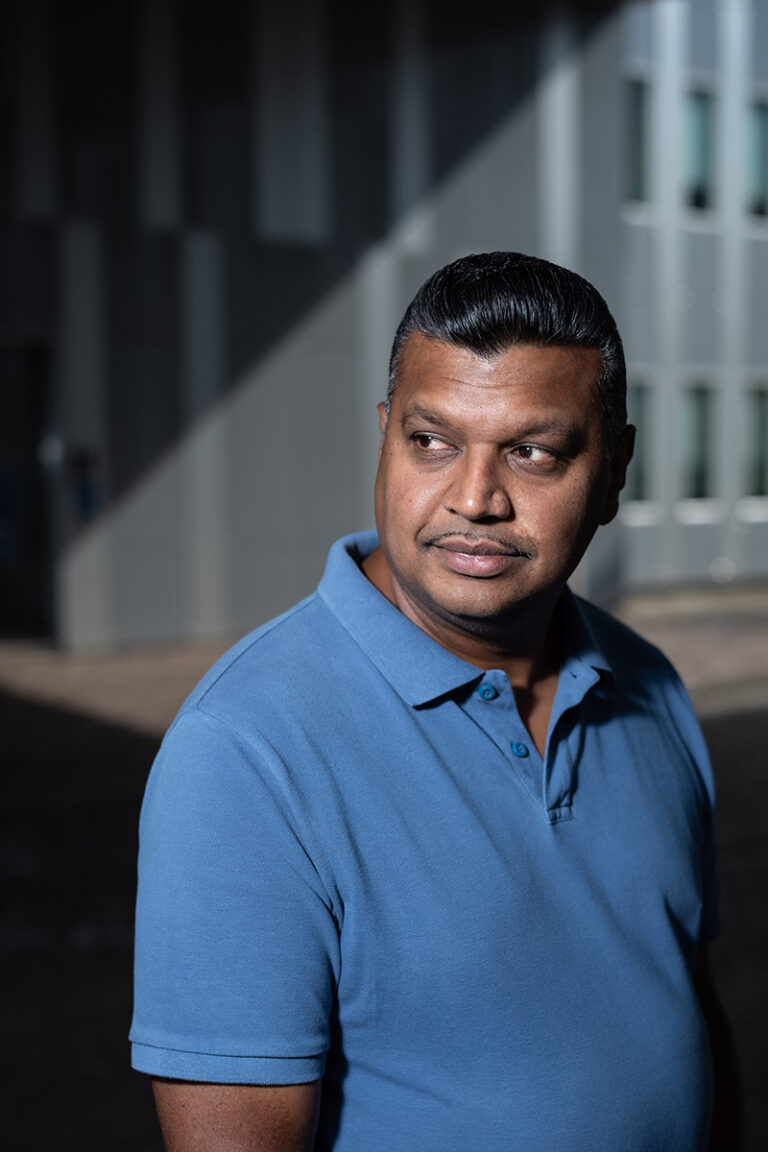
You’ve been a confidential counsellor since 2018. What does that role look like at VU? “Confidential counsellors are there for issues involving inappropriate behaviour: bullying, intimidation, aggression and sexual harassment. At VU, power dynamics and hierarchical relationships often play a major role. I help people think through their options and explain the possible consequences, so they can decide for themselves what feels right. That’s what I like about the role: I help people develop skills they can continue to use throughout their careers. It’s hard to say it’s fun work, because I’m dealing with people who are struggling. But it’s deeply rewarding.”
Sandjai Bhulai (50)
2023 – now
Technical Chair, Mondriaan Fund
2020 – now
Owner, PersonalAIze
2019 – now
Committee member for organisations including UWV, AethiQs, NWO and the Dutch Ministry of Finance
2018 – now
Central staff confidential counsellor, VU
2016 – now
Professor of Business Analytics, VU
2011 – 2016
Associate Professor, VU
2010 – now
Owner, Santrix
2003 – 2011
Assistant Professor, VU
1998 – 2002
PhD in Operations Research / Applied Mathematics, VU
1994 – 1998
MSc in Business Mathematics and Informatics and MSc in Mathematics, VU
Soon, you’ll be stepping down. Why? “It’s no longer possible for me to combine this work with my position as a professor and my other responsibilities. Over the years, it has become clear that confidential counsellors need to be more visible and more available. When I took on the role, Mariëlle Roosemond and I were the only two counsellors for three thousand employees. That simply wasn’t enough. A pilot with decentralised confidential counsellors proved successful. The next step comes in October: a central, diverse pool of confidential counsellors.”
Why were you approached for the role eight years ago? “The coordinator knew me and thought I had the right qualities. Being able to listen is essential, as is empathy. But you also need to read people and cope with injustice. There are cases from years ago that still stay with me: people who became deeply emotional or had suicidal thoughts. Strong colleagues who found themselves in situations that completely broke them. I have to be able to leave that behind at the end of the day.”
Wasn’t that difficult to combine with your other work? “I wanted to give something back to the VU community. The fact that I’m now a professor is partly down to talent, but also to meeting the right people and receiving support along the way. I’ve spent more than a third of my life here. That means I know the people and the organisation, and I understand the challenges people can run into.”
Don’t you sometimes wish you could do more than simply listen and give advice? “If I did, I’d become a mediator of sorts. We have mediators at VU too, so I can refer people to them when appropriate. I do regularly meet with the executive board to discuss the kinds of cases we’re seeing and whether we’re noticing any broader trends.”
Has a changing society led to more tension in the workplace? “I do see shifts in the way inappropriate behaviour is experienced. In the past, people were generally more explicit about setting their own boundaries. Now, they often expect others to recognise those boundaries without being told. That makes things difficult for everyone, especially as society has become more sensitive. People want to avoid conflict, but unresolved issues tend to simmer beneath the surface.”
Stories about unequal power relationships in academia aren’t new. Do you think there are systemic problems? “In academia, everyone knows everyone. People don’t want to damage their reputation. You’re a specialist in your field, and there are only so many places you can go. That’s why people hesitate to file a complaint or speak out publicly. Fortunately, I see VU placing increasing emphasis on social safety and setting higher standards for leadership. The hierarchy is gradually becoming less rigid.”
What advice would you give staff members who are carrying around a bad feeling? “Don’t wait too long with talking to a confidential counsellor. Many people who come to us no longer see their own strength; all they feel is their vulnerability because they can’t find a way out of their situation. Very often, a single conversation is enough to let off steam and hear that you really aren’t crazy.”
Confidential counsellors
VU’s confidential counsellors provide a listening ear and support to staff members who experience inappropriate behaviour. They help employees explore informal ways of resolving workplace issues. Contact vertrouwenspersonen@vu.nl for questions, information or to request a confidential meeting.