
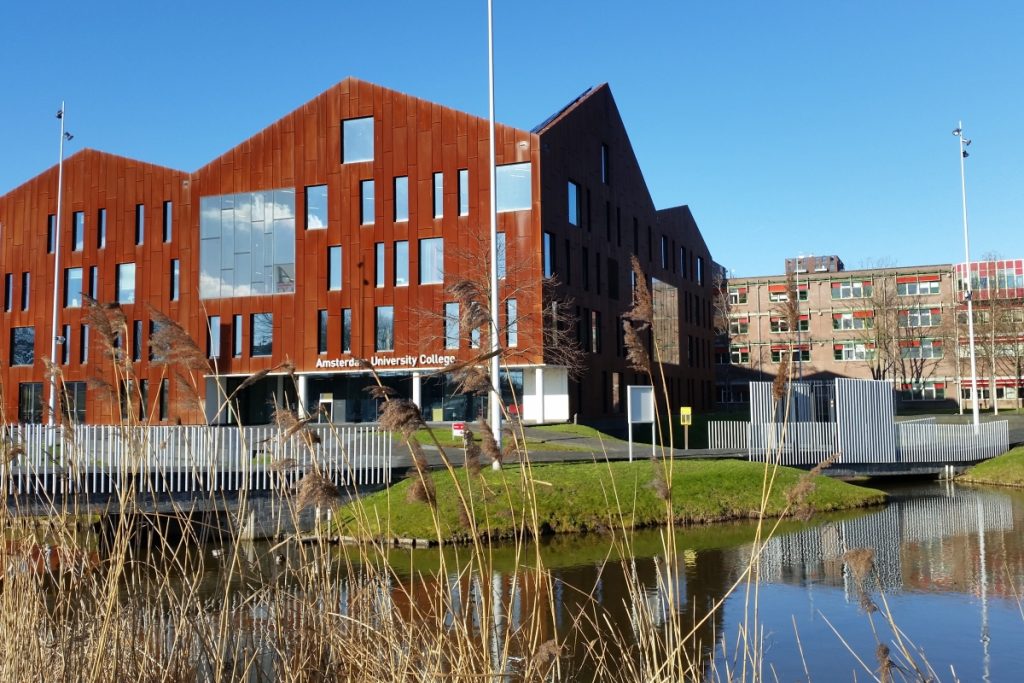
With applications declining and political pressure on international education, the executive boards of UvA and VU have selected a new plan for Amsterdam University College. ‘We will anchor sciences more firmly into our liberal arts identity’, AUC dean Bruce Mutsvairo announced in a memo to students and staff on 26 October.
Apart from curriculum changes, the plan aims for 50% of AUC’s future students to be Dutch, up from around 20% currently. AUC will also explore dropping the requirement for students to live in AUC residences. Currently enrolled students will not be affected, as, by law, the college has to allow them to finish their degree in its current form.
The plan is based on the route of Science and Global Citizenship, one of four potential scenarios for AUC’s future that Mutsvairo outlined in a report presented to the executive boards in July (see box below).
Democratic and collaborative
The boards tasked Mutsvairo with preparing the report shortly after he took up his role as interim dean in September last year. At the end of the year, he informed students of his assignment, stating it aims to ensure AUC is ‘responsive to its environment’ and ‘building further on its strengths’. It also came as AUC’s current strategic framework, ‘AUC Next’, was due to expire in 2026.
Mutsvairo asked a group of AUC’s students, staff, and alumni, along with UvA and VU staff, to form a taskforce and collect data about the college that would inform the report. The aim was to ‘complete this assignment democratically and collaboratively’, he wrote in an email to students.
The report, made public for the first time last month, goes over the risks associated with AUC’s current model. It states the boards requested the assessment because of concerns regarding ‘AUC’s added value to the parent universities’, ‘social and political pressures’, and ‘declining Dutch student enrolments’, among other aspects.
Serious financial threat
Leaving AUC unchanged could result in a number of risks, the dean’s report says. The college could face a decline in enrolments, as it risks competing for candidates against other interdisciplinary programmes, including those run by UvA and VU. The report also says the risk is particularly high considering national projections, which predict a nationwide decrease in university enrolments.
Only around 5% of AUC’s income is fixed funding
The budget of the college relies heavily on tuition fees, with only around 5% of income being fixed funding. A decline in enrolments would pose a serious financial threat, states the report, calling for a new approach that would distinguish the college from similar programmes.
Fewer than 1,200 students applied to AUC for this year’s intake, compared to around 1,500 annual applications the college usually received in the previous years.
Vulnerable to politics
Another vulnerability of AUC seems to be potential legislation changes. Part of why the report was requested was the “shifts in the Dutch government”, says Willemijn Eijsink, who graduated from AUC in July, served as chair of the student council and was a student representative on the Strategic Advisory Group, the part of the taskforce that advised the dean during the process.
The report states that if a new law were to require all English-taught programmes to revert to Dutch, ‘AUC’s current educational model would no longer be viable’.
AUC would also come under threat if budget cuts hit UvA and VU, preventing them from providing AUC with academic staff. Currently, over 50% of AUC’s teaching hours are provided by staff from the two host universities.
However, the report does not see closure as a necessary step. It describes AUC’s financial position as ‘healthy’ and states there is ‘no financial reason to consider closure of AUC’. Closing the college would also be costly: as student numbers decline while some fixed costs remain, AUC would run a deficit of more than €6 million in its final year alone.
Blueprint for change
The report presents four possible scenarios, of which the executive boards of UvA and VU chose the Science and Global Citizenship scenario.
The memo states that this scenario offers a ‘solid blueprint for change’, but the specifics of how the plan will be brought to life will depend on an implementation plan and business case. These will be developed by AUC staff and presented to the executive boards by the end of January 2027. Still, the report’s description of the scenario offers a glimpse of the general direction in which AUC is heading.
The scenario balances AUC’s current interdisciplinarity with a clearer focus on sciences that would allow the college to ‘take stronger ownership of its institutional narrative’. This comes as a response to the risk of AUC blending in with similar programmes.
Under this scenario, AUC would continue offering both Bachelor of Arts and Bachelor of Science degrees. But the current majors (Sciences, Social Sciences, and Humanities) would be replaced by specialisations or tracks. These would include specialisations such as Media and Culture or International Relations, which would lead to a BA degree.
Scientific literacy
In AUC’s current form, students need to take two courses from each major that’s not their own, and a set of Academic Core courses. Under the new scenario, all students would take mandatory courses that would ‘foster scientific literacy’ and ‘cultivate responsible, community‑engaged science’. Other than that, the curriculum would remain ‘largely open’, with students only choosing their specialisations in their third year.
AUC would also offer some of its academic staff the possibility to convert from the teaching-focused D-line positions to the more research-oriented U-line. The research conducted by the faculty would not receive any substantial funding from the college, and the costs would have to be covered by AUC’s existing scholarly development budget.
The report also mentions that AUC would establish ‘a centre’, which would be ‘a hub for undergraduate research’, and the ‘driving force’ for converting the AUC faculty to the U-line. What exactly the centre would be, is left unclear.
All non-Dutch-speaking students would take a mandatory Dutch course. This policy would address the ‘national concerns regarding internationalization’, the report states. All of these changes are mere suggestions on how the scenario could be implemented. Until the implementation plan is revealed, it is unknown which of these will be brought to life.
Not in the report
The memo also states that ‘a non-residential option’ will be explored for future students. According to the student council, students will no longer be required to live in the dorms, but the details of the future arrangement have not yet been decided. The report, by contrast, argues against making AUC non-residential, stating that the dorms are ‘an educational instrument […], rather than simply a provision of accommodation’.
‘The dorms are an educational instrument, rather than simply a provision of accommodation’
The report does not mention the goal of AUC’s student population being 50% Dutch, which was only announced in the memo. “If you look at the broader political context, and certainly the previous cabinet, you can understand where that comes from”, says Eijsink, adding that the population of AUC was a lot closer to being 50% Dutch when the college was founded than it is now.
Against the majority
As the scenarios were being developed, most AUC students and staff advocated for the minimal change option, labelled the Baseline scenario, the report states. Despite this, dean Mutsvairo recommended the Science and Global Citizenship scenario, stating in the report that ‘the nature of this assignment […] appears to call for a choice between one of the change‑based scenarios’.
‘We believe scenario 2 [Science and Global Citizenship] offers the best potential outcomes for students compared to the other proposed scenarios’, the AUC student council has stated, adding that they are ‘committed to maintaining the diversity of the AUC course offering and its community.’
Eijsink says she understands the opposition, as she was “change resistant” at first herself. But in the end, she says, the scenario is meant to attract prospective students.
The chosen scenario “was the most appealing one out of the ones presented”, says Eijsink, but adds that she is “really curious what will happen with implementation, because that will make all the difference to whether I’m positive about AUC’s change”.
Dean Bruce Mutsvairo and members of AUC staff declined to comment at this time.
Scenario 1: Baseline
AUC stays mostly unchanged. It continues to offer three majors: Sciences, Social Sciences, and Humanities, and its students can graduate with a BA or BSc. The current rule of 50% of students being Science majors remains.
Scenario 2: Science and Global Citizenship (chosen scenario)
AUC foregrounds science but remains highly interdisciplinary. Both BA and BSc are still offered. The three majors are replaced by tracks and specialisations, including ones built around humanities and social sciences. All students must take mandatory courses on scientific literacy.
Scenario 3: Frontier Science
AUC becomes a BSc-only college and all students study science. To maintain some interdisciplinarity, a small selection of humanities and social science courses is mandatory for all students to take.
Scenario 4: Closure
Current AUC students are allowed to finish their degree, but no new students are admitted. The college closes after its last students graduate.