
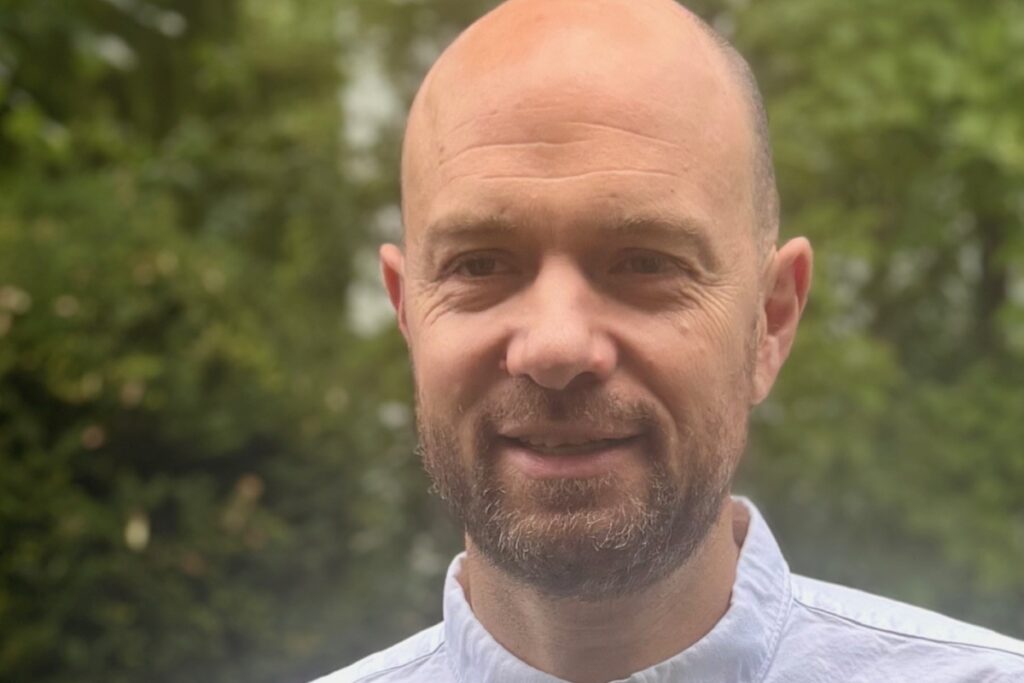
The decision to leave Israel weighs on his whole family, he explains. “It’s something I think about nearly every day. My family and I discuss it almost daily, and it’s a process. We’re still trying to address all the different needs among the different family members. Obviously, it’s a complicated task, but I think that this move will, in retrospect, be something that was a good choice.”
Mann trained as a lawyer in Tel Aviv before completing his master’s and doctoral studies at Yale Law School. Since 2016, he has taught international law, political theory and human rights at the University of Haifa, focusing on migration and refugee law, the law of the sea and international criminal law – and has been an outspoken public voice on Palestine and Israel.
The sea as inspiration
His research keeps returning to the sea. His first book, based on his PhD, traces the legal history of migration by boat, long before it dominated the headlines. Since the mid-twentieth century, migrants and refugees have used the sea “as a way to assert their claims, as a way to try to connect to governmental authorities.” For Mann, that encounter – between a person of unclear citizenship, standing on no state’s territory, and the authorities they seek to reach – offers a way to understand human rights: a test of what protection the law offers to a person simply as a person.
The Tulip Fund
Academic freedom is under mounting pressure worldwide. The Tulip Fund lets top international researchers continue their own line of research in the Netherlands. It helps Dutch research organisations recruit top talent from abroad facing growing threats to academic freedom in their home countries, strengthening the Netherlands' position at the forefront of international research. Funded research may be fundamental, applied or practice-oriented – there are no restrictions on content.
At VU, he wants to trace how ideas from the maritime context have shaped law elsewhere, from images of piracy in international criminal law to maritime rules feeding into ideas about space law. “Why and how has the sea served as a resource for legal ideas for other spaces?” is the question he wants to answer next.
Grateful
Mann doesn’t hide his appreciation for the Tulip Fund. “I’m very grateful. I think it’s an important move by the Dutch government.” He has seen similar schemes in Germany, but rates the Dutch one especially highly. “The Netherlands has been successful in creating a framework that offers a lot of room for academic freedom, independence and research.”
Why did he choose VU? “I thought of this as an opportunity to have a lot of time for research at an excellent university in my field. VU is very good in international and transnational law in the context of law and society, which are the areas that I’m also engaged in.”
He is quick to credit the people who helped him get there, singling out Galina Cornelisse for her role in supporting the application, and former VU professor Thomas Spijkerboer for pointing him towards the opportunity in the first place.
Sense of responsibility
So what does he hope for his time at VU? Mostly, more time and the right company. “I’m finishing a book now that explores how democratic principles can be preserved under conditions of climate breakdown and mass displacement. After that, I want to write another one,” he says. Beyond his own writing, he is hoping for “new and brilliant colleagues” and the kind of conversations that lead somewhere. “I hope to have synergies in terms of our ideas, maybe to write with people.”
The Tulip Fund is pitched at leading international researchers, a label Mann accepts with some hesitation. “I feel flattered, but I also realise that such labels, looked back on after a few years, can seem either justified or just fleeting moments that passed. The responsibility is still on my shoulders to prove I can offer ideas that a new generation of scholars in international law will find important and useful. And that’s what I hope to do.”