

Just after last block’s final deadlines, students and professors from the International Crimes, Conflict, and Criminology Master’s programme travelled to Sarajevo, Bosnia, for a week-long study trip. What we uncovered, beyond the stories of mass atrocities and post-conflict transitional challenges after the Bosnian War from 1992 to 1995, were the contradictions that sparked the war, sustained it, and still exist thirty years later.
Throughout the year, students of this Master’s have studied mass atrocities and international crimes from multiple disciplinary perspectives. The Yugoslav Wars and the Srebrenica Genocide served as case studies for our learning. The study trip to Sarajevo was a cumulative and contextualising experience for the students in attendance, allowing them to learn about the established facts of the violence that occurred between 1992 and 1995, and to experience the active contestation of historical narratives that proliferate beyond the General Framework Agreement for Peace in Bosnia and Herzegovina, which ended the war.
A town of heroes
While these Dayton Accords were signed on 21 November 1995, by the presidents of Bosnia and Herzegovina, Croatia, and Serbia, peace, as explained by the experts we encountered, requires more than just an absence of conflict. Although arms were officially put down that winter, and commanders of the armies retired their soldiers from the battlefields, the remnants of the war are still visible in the bullet holes in the houses, murals of convicted war criminals, and the competing historical narratives that continue to divide the country.
These remnants were immediately clear on the first day, when we visited several towns in Republika Srpska, one of the two confederal entities that make up Bosnia and Herzegovina. Guided by Adnan, a veteran of the Army of the Republic of Bosnia and Herzegovina, we left the capital city for smaller towns where the Bosnian Serb influence became increasingly clear. Serbian flags lined the roads and waved atop town buildings, signalling the different reality we were driving into. A mural of convicted war criminal Ratko Mladić, accompanied by a Serbian flag along the road into Kalinovik, stood prominently as our bus drove into the former military officer’s hometown. In the ‘Town of Heroes’ centre, a towering statue of Mladić watched over the memorial site. The mural, honouring a convicted war criminal, signals a narrative, one in which Mladić is not a perpetrator of genocide, but a ‘defender’ and hero. More than thirty years after the end of the war, such representations point to the persistence of alternative historical truths; what is internationally recognised and legally established as genocide is, in local contexts, reframed, minimised, or outright rejected.
Abandoned and repurposed hotels
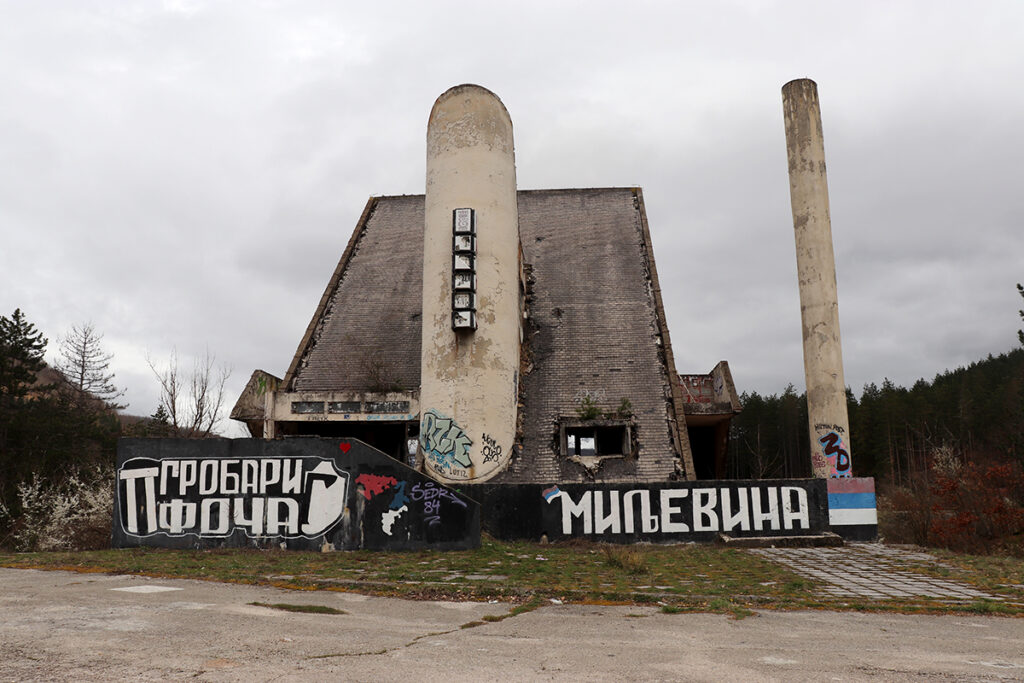
Perhaps the most striking contradictions on this day emerged during the visits to Miljevina and Višegrad. In both towns, hotels were repurposed during the war for torture and sexual violence campaigns against Bosniak men and women. In Miljevina, only the skeleton of the hotel still stands, with broken glass and graffiti scattered in its interior. With no sign or plaque to commemorate the crimes committed, one could easily dismiss this building as just another abandoned structure or a relic of economic decline, rather than a site of atrocity.
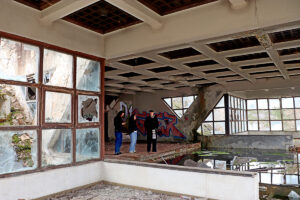
In Višegrad, the spa hotel Vilina Vlas also served as a site where Bosniak civilians were detained, tortured, and subjected to systematic sexual violence. As our bus approached the building, our guide told us we could step out and explore; he himself chose to remain on the bus, visibly reluctant to return to a place marked by such violence. While Vilina Vlas was one of the main rape camps during the war, denial lives on to such an extent that the spa is currently in use; guests swim in the pool where dead bodies floated, and sleep in the same bedframes where Bosniak women and girls were raped. As I stood at the steps up to the entrance to take photos, a man walked out to smoke a cigarette. I looked at him as he smiled back, and I wondered if he knew or cared about those women and girls in whose site of trauma he now swims. No plaque to commemorate the victims here either; no recognition of the horrors perpetrated, but the ultimate denial.
Entrenched divisions
With questions about whether the scarce memorialisation of Bosniak victims in Republika Srpska is due to a will to forget or active denial, we visited the Organization for Security and Co-operation in Europe (OSCE) Mission to Bosnia and Herzegovina the next day. What was planned to be an hour-long presentation unfolded into a three-hour candid discussion about the challenges of post-conflict transitional justice in a country struggling to turn the page on its violent past.
The OSCE is the world’s largest regional security organisation with 57 member states and was founded to act as a multilateral bridge between East and West during the Cold War. Fostering comprehensive security through – often quiet – diplomacy, the OSCE works with several mandates from its secretariat in Vienna, Austria, and extended influence through its field missions located throughout mainly (South) Eastern Europe and Central Asia.
The OSCE Mission in Bosnia and Herzegovina works as mandated by the Dayton Accords framework. This agreement ended the war and outlined the country’s constitutional foundation; Bosnia’s constitution does not exist as a stand-alone document, but as an annex – Annex 4 – embedded within the peace agreement itself. In this sense, the state’s very constitutional existence is subordinated to the terms of the settlement that ended the conflict, a reminder that Bosnia and Herzegovina was not so much constructed as a cohesive political project but negotiated into being as a compromise between warring parties. This arrangement reflects the conditions under which it was forged: a settlement between actors with minimal trust and competing visions of the state. While it succeeded in halting the violence, it also entrenched a high degree of political division between the entities, leaving a fragmented system in which cooperation is necessary, but rarely natural.
Wall against political will
Building trust within this context, the ultimate currency of sustainable peace, is a great challenge in a post-conflict setting; biased narratives that antagonise the ‘other side’ put up a wall against political will. The country’s tripartite presidency, which gathers Bosniak, Serb, and Croat representatives, depends on compromise for even routine governance. Yet, in practice, even relatively uncontroversial policy issues become politicised along ethno-national agendas, as leaders often derive greater political capital from obstruction than from cooperation. In this way, the very institutional arrangements designed to secure peace continue to reproduce the divisions they were meant to manage, making it difficult to cultivate trust.
The OSCE advisers emphasised that trust must be built beyond the executive state level, particularly in everyday institutions like education and the judiciary. In Bosnian schools, fragmentation is stark: with more than ten ministries of education, there is no unified curriculum, and children grow up learning fundamentally different versions of the country’s history, borders, and war. These parallel narratives produce separate collective memories, making dialogue difficult when there is no shared baseline of facts.
At the same time, the slow and uneven prosecution of war crimes further undermines trust. Cases face years-long delays and inconsistent sentencing, and are often perceived as selective or politically motivated. When communities see ‘their’ perpetrators punished while others remain untouched, grievances are reinforced rather than resolved. As the advisers noted, accountability delivered unevenly can entrench division, and the legal backlog due to an overburdened legal system raises questions about achieving justice through (only) legal retribution.
Cheering for Italy
Yet, that same afternoon, we encountered a starkly different perspective. Genocide scholar Hikmet Karčić described Bosnia and Herzegovina as, in some respects, a ‘model’ of post-conflict reconciliation. His argument appears to rest on a more minimal definition of reconciliation: the absence of renewed large-scale violence, and the ability of former adversaries to live side by side. By that measure, Bosnia has achieved a fragile form of stability, even if deeper social cohesion remains elusive.
For the OSCE advisers, however, this fragility is precisely the problem. The absence of a shared political community becomes visible in the most unexpected places, even in sport; that evening, Bosnia and Herzegovina was set to play Italy in a World Cup qualifying play-off final, and the OSCE received reports that a portion of the country would be cheering for Italy.
Hours later, Sarajevo told a different story. After a tense penalty shootout, Bosnia and Herzegovina won. The city erupted. Streets filled with people draped in flags, car horns echoed through the night, and chants of “I am from Bosnia, take me to America” carried through the crowd. For a moment, the divisions we had spent the day dissecting seemed to dissolve into collective celebration. But even there, the question lingered; Sarajevo is mostly populated by Bosniaks, so would these echoes reach Republika Srpska cities too? Standing in the packed square waiting for the players to arrive, I asked two fans, Kenna and Din, whether this win could bring the whole country together to celebrate. There was a brief pause before the answer came: “I hope so.”
Ghost town
On the final day of the programme, we set out for Srebrenica, the town in Eastern Bosnia where the genocide against the Bosniak population has been officially recognised. As we drove through the striking blue canyons that cut across the landscape, the natural beauty stood in stark contrast to the history we had been learning, since the roads we followed and the hills we passed had borne witness to violence on an unimaginable scale.
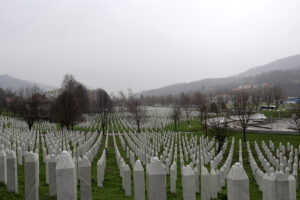
Srebrenica itself is a ghost town. There are more graves commemorating the over 8,000 Bosniak men and boys murdered by the Bosnian Serb army than there are current residents. With many families displaced or wiped out, countless houses stand empty, their bullet-marked facades left without anyone to return to or inherit them. Most of this destruction is a remnant of the war, but every year on 12 July, the day after the International Day of Reflection and Commemoration, radical Bosnian Serb fanatics drive through the town waving Serbian flags, singing nationalist songs, and shooting at houses known to be Bosniak. For many here, these acts are a yearly reminder that the past is still being fought over in the present.
Even the memorial centre itself, where visitors can explore several exhibitions housed in the former battery factory that served as the Dutch battalion’s base during the massacres, shows the disagreements about history. The permanent exhibition ‘Failure of the International Community’, co-funded and co-created by the Dutch government, presents the genocide as the result of NATO’s bureaucratic paralysis. Yet some argue that this framing shifts responsibility onto an abstract system rather than the individuals who failed to protect Bosniak civilians. Just next door, the newer (Turkish-funded) exhibitions offer a different emphasis, presenting the stories of victims through photographs, short documentaries, and personal belongings, including shoes recovered from some of the murdered Bosniak civilians. Still, thirty years later, accountability remains a subject so disputed that even here, at the memorial itself, few agree on where responsibility truly lies and whom to commemorate.
The Bosnian masterclass
What we were left with, beyond new experiences and knowledge about Bosnia and Herzegovina, were enduring questions about what ‘peace’ means in a post-conflict society, and how fragile that peace can remain. Across Sarajevo, Republika Srpska, and Srebrenica, the Bosnian post-war landscape showed that transitions from war to peace are rarely linear. Competing versions of history and the constraining Dayton framework keep entrenching the country’s underlying political and social divisions.
These tensions remain deeply visible and affect all layers of social reality, coexisting with the simplicities of everyday life.
It’s important to resist simplified narratives
We shared plates of burek and ćevapi in Sarajevo’s old town, heard church bells and Adhans from mosques overlap, and sang karaoke with Adnan on the bus back from Eastern Bosnian landscapes marked by atrocity. It is precisely this simultaneity, of rupture and normality, of division and cohabitation, that made the trip so fascinating. Bosnia and Herzegovina is both a model of peace and a lived reminder that post-conflict realities are neither static nor complete. As Adnan noted, “Bosnia is a masterclass of contradictions”, and engaging with these underscores the importance of resisting simplified narratives – also in contemporary conflicts, where layered histories and competing narratives continue to shape how conflict and peace are pursued and experienced.