
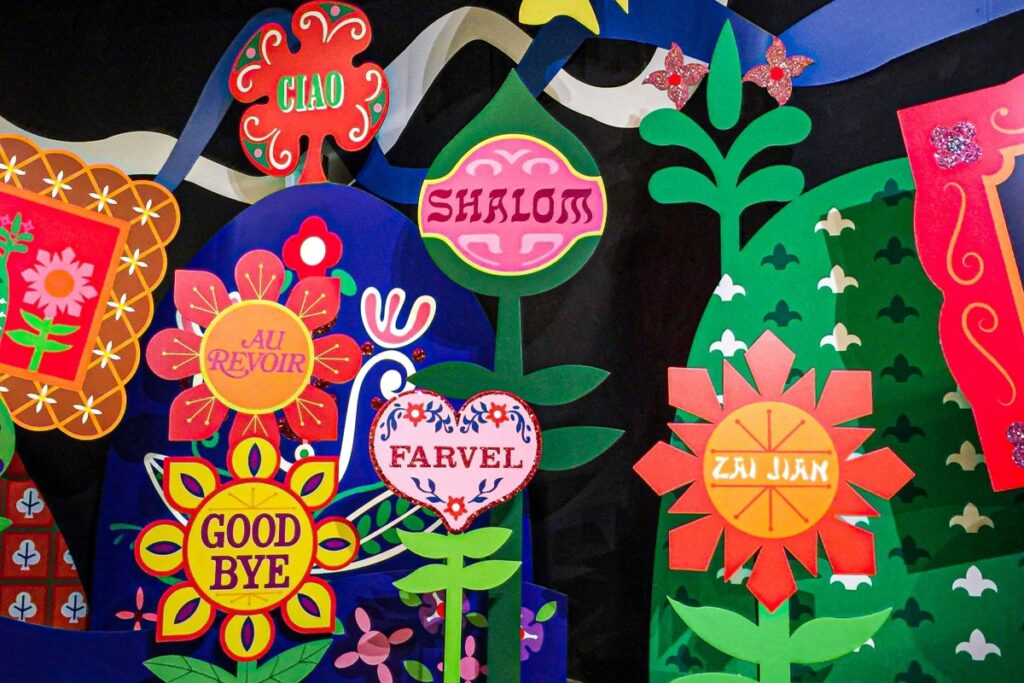

Roze khob dashte bashi! Or: happy Mother Language Day! That is the translation from Dari, one of the many languages spoken in Afghanistan. The fact that I had never heard of it before today is actually a disgrace, given that it is the mother tongue of some 75 million people and is spoken by more than 300 million people worldwide.
The organisation behind Mother Language Day, the NT2 department of VU, asked itself two questions while preparing for this afternoon. First: what is the significance of someone’s mother tongue? And what space is language allowed to occupy at the university? Writer and columnist Abdelkader Benali, our guide during the speaking session, tells us why the language Tamazight feels so intimate to him. He speaks about an episode of the series The Pitt in which a woman ends up in intensive care but does not speak English.
In this woman, Benali sees his own mother, for whom he often had to translate between Dutch and Tamazight at the doctor’s. He describes what it’s like to learn a second language – that before you begin, you must shake off your mother tongue, a language connected to your past, to open yourself up to a new one.
Releasing memories
English Literature student Amir Naiemi and a friend, in keeping with the theme of saying goodbye to one’s mother tongue, perform a story in which Aladdin’s mother takes centre stage. Accompanied by Naiemi on musical instrument sitar, the spirit tells her that her son will never again recognise her. The sadness the mother feels as the spirit speaks, symbolises the fear you may experience of losing your mother tongue while learning a new language.
Maxime van der Reijden, a creative writing student, shows in her performance of her poem Ode aan het Leids [Ode to the dialect of the city of Leiden] that the mother tongue always remains hidden somewhere in a symbolical chest. A chest that, with great force and effort, can suddenly spring open in moments of fear or anger, releasing the memories connected to that mother tongue. For her, this brings her grandparents to the fore, with their Leiden dialect, smoky surroundings and the smell of port. With her poem about the dying Leiden dialect, Van der Reijden seeks to show how people can be proud of their mother tongue – a language she herself can no longer speak.
All in all, the message of Mother Language Day is to make people more aware that language is not merely a means of communication, but also an expression of culture. After Van der Reijden’s poem, there are four language workshops (Arabic, Turkish, Farsi and Russian) and a course in parallel language use, in which participants explore how to hold meetings effectively with multilingual colleagues. The workshops are given by enthusiastic NT2 students (Dutch as a second language).
Involving students is an important part of the afternoon. “People with a different mother tongue can contribute something and not only learn something”, says NT2 staff member Camille. And I agree. To show that I truly learned something from this day, I would like to end in the same language in which I began – Dari. So here it is: Khoda Khafez! (Goodbye!)