

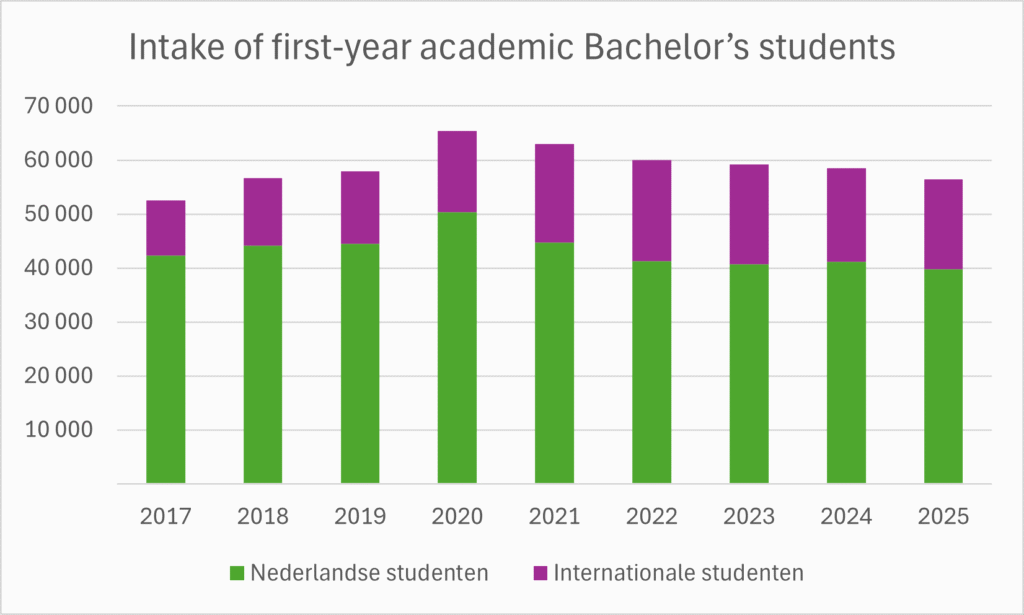
Approximately 56,000 Bachelor’s students enrolled at Dutch universities in 2025. That is 3.4 percent less than last year. For the fifth year in a row, the number of first-year students has decreased. The drop is visible among Dutch students (down 3.3 percent) as well as international students (down 3.6 percent).
Dutch students
Among Bachelor’s programmes, only law saw an increase in the number of Dutch first-year students. For programmes in the field of Behavioural & Social Sciences, numbers remained stable, while enrolment declined in all other programmes.
According to Universities of the Netherlands (UNL), the drop can be explained by fewer pre-university (VWO) pupils going on to enrol in a degree programme: fewer VWO pupils took their final exams, and the pass rate also declined. In addition, more VWO pupils are opting for a gap year.
International students
International enrolment also fell, by 3.6 percent. Students from EEA countries in particular are increasingly turning away from Bachelor’s programmes in the Netherlands.
© HOP, source: UNL
The outgoing Schoof administration wanted to cut funding related to these students through a new law that aimed to reduce the number of internationals, including the introduction of a ‘language test’ for English-taught programmes. However, the new coalition government has decided to scrap this plan.
Interestingly, sectors that are plagued by shortages of skilled workers, such as engineering and health, are attracting more international students. Nearly one in five international students who started a Bachelor’s programme in the Netherlands in 2025 chose an engineering degree.
Universities of technology
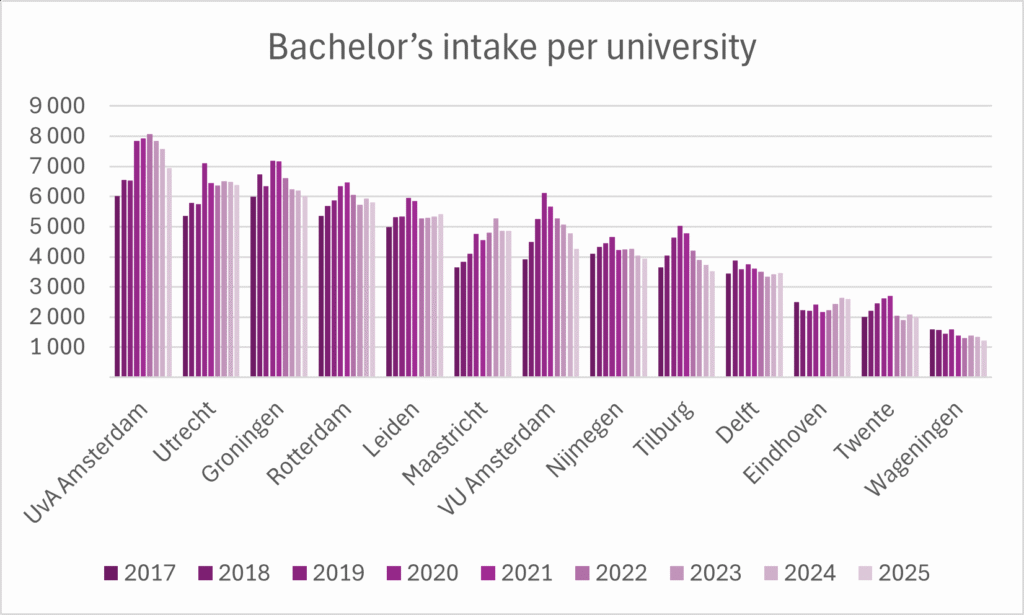
Delft, Eindhoven and Wageningen were the only universities to attract more international students in 2025 than in 2024. In Wageningen’s case, the count rose by a single student. However, the universities of Eindhoven and Wageningen attracted fewer domestic students, meaning their overall intake still declined.
Despite fewer international students coming to Leiden, the university nevertheless saw more first-year students starting their studies: the number of new Dutch Bachelor’s students rose by almost six percent.
The University of Amsterdam remains the largest university in the Netherlands, but welcomed more than six hundred fewer first-year students in 2025 than in 2024. VU Amsterdam also saw its first-year intake fall, by roughly five hundred students.
© HOP, source: UNL
Decline
In total, 332 thousand Bachelor’s and Master’s students are enrolled at Dutch universities. Of these, approximately 91 thousand are international students. Last year, the total number of students was 338 thousand.
UNL is concerned about the decline. “Without a strategy to invite talent, we are undermining our academic base, societal innovation and our economy”, says UNL president Caspar van den Berg.
Top talent
The government parties have included such a talent strategy in their new coalition agreement. “Higher education institutions will be given more opportunities to attract top international talent and retain domestic talent”, write D66, CDA and VVD.
At the same time, the coalition parties consider it important to ‘control’ the influx of international students and want to make “binding administrative agreements” on this with educational institutions.