

This is according to the new Women Professors Monitor, which was released today. Each year, this report – an initiative of the Dutch Network of Women Professors (LNVH) – maps the differences between men and women in Dutch academia.
Thirty percent is a symbolic milestone, the authors write. It indicates that women are no longer the exception at the highest levels of research, and that there’s enough momentum to drive lasting change.
Not quite
But that milestone hasn’t quite been reached yet. The latest available data, collected on 31 December 2024, shows that women accounted for 29.9 percent of all full professors at the end of last year. Moreover, this figure represents the share of full-time equivalent (FTE) roles held by women. In terms of individuals, the proportion of women is slightly lower.
Nevertheless, the authors write that they “choose to mark this moment as the achievement of the 30 percent milestone”.
By university
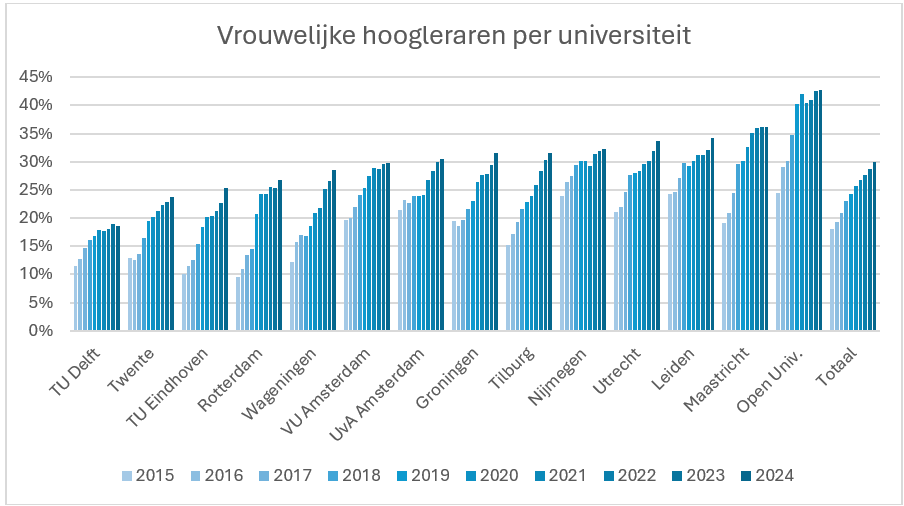
The proportion of women full professors increased at all Dutch universities in 2024, except at Delft University of Technology, where it declined from 18.9 to 18.6 percent. Delft is also the only university where fewer than 20 percent of full professors were women.
A total of six universities have yet to reach the 30 percent threshold. Besides Delft, these are VU Amsterdam (29,8%), Wageningen University, Erasmus University Rotterdam, and the Eindhoven and Twente universities of technology.
Amongst the universities that have passed the symbolic milestone, the Open University stands head and shoulders above the rest. At this small, Limburg-based institution specialising in distance learning, 42.8 percent of full professors were women last year.
Women tend to be better represented in other senior positions at universities. In 2024, 21 of the 41 executive board members were women, representing a majority.
Meanwhile, 36 percent of faculty heads and research institute directors were women, as were 47 percent of department heads.
Other countries
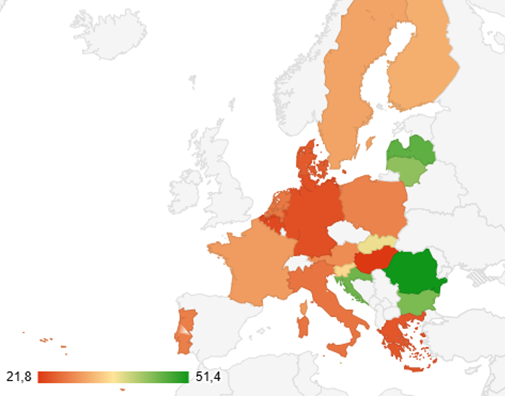
Compared to other countries, the Netherlands is by no means ahead of the curve. While close neighbours like Germany and Belgium are doing even worse – in 2022, the share of women full professors was still below 25 percent in both countries – there are countries where women are much more likely to reach the top. In Romania, for instance, more than half of all full professors are women.
Women full professors in EU countries (2022)
KNAW and NWO
The LNVH also monitors the representation of women at the institutes of the Royal Netherlands Academy of Arts and Sciences (KNAW) and the Dutch Research Council (NWO).
While the top-level researchers at these institutes aren’t called ‘full professors’, 23.8 percent of those on comparable salary scales at NWO are women. The monitor points out that this is higher than average for the science and engineering sector, to which these institutes belong. At the KNAW institutes, women accounted for 28 percent of staff on these salary scales.
Are things moving in the right direction for women in science? The LNVH warns against complacency: “Growth is still modest and unevenly distributed across institutions and disciplines”, the monitor states. At the current rate, it could take twenty years to reach true parity.