
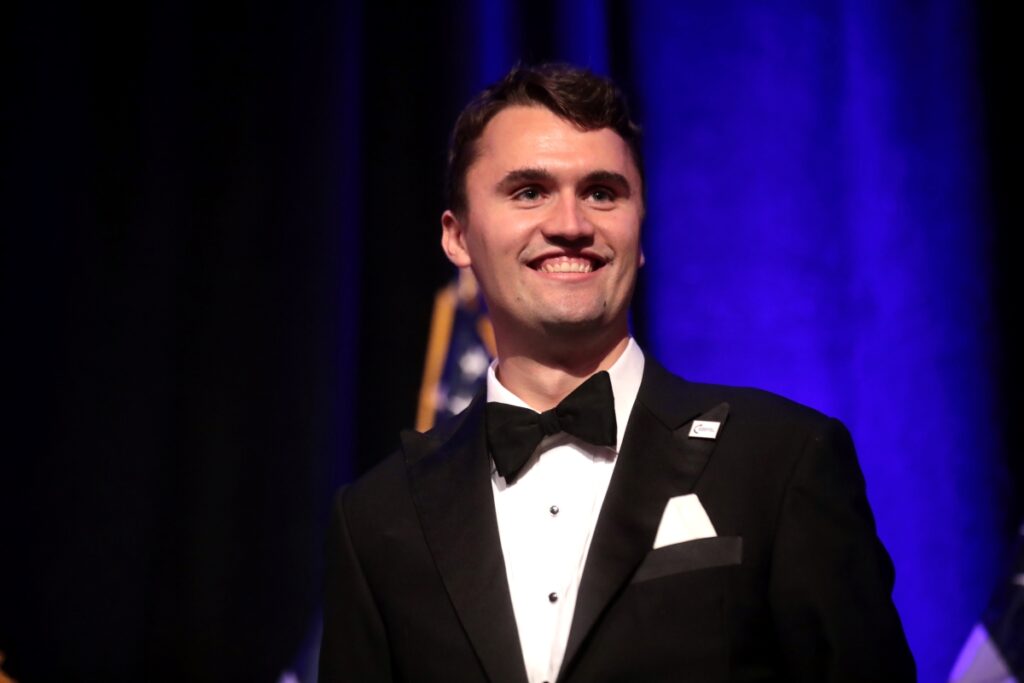
The assassination of the young Republican activist Charlie Kirk at an event held at Utah Valley University has plunged the US into turmoil. (At the time of writing, the perpetrator was still at large.)
Kirk was a notorious figure in American higher education. He advised young people not to go to college and even called university education a scam. He also believed that universities were too liberal and progressive, and that they suppressed dissent.
Prove me wrong
Nevertheless, Kirk enjoyed visiting campuses to debate students, challenging them to prove him wrong. His social media channels are full of videos of him trouncing progressive students. Turning Point USA, the youth organisation founded by Kirk in 2012, ran a website that would ‘expose’ radical lecturers.
Kirk was also friends with Donald Trump, speaking at his most recent inauguration earlier this year. During his second term in office, Trump has repeatedly attacked academic freedom and progressive ideology. He has also expressed strong disapproval of pro-Palestinian protests on college campuses.
Kirk himself denounced everything he deemed progressive, from abortion rights to diversity policies. In his book Campus Battlefield, he argued that Americans were engaged in a war for the ‘soul’ of their country. He also spread misinformation, for example about the death of George Floyd, claiming that Floyd had died not from police brutality, but from a drug overdose.
Blame
American news media report that Kirk’s murder could have implications for freedom of speech in American academia. After all, it’s difficult to argue that conservative activists are safe at US universities when one of the most prominent figures on the American right has just been assassinated on a college campus.
But who will ultimately be blamed? Some universities have already fired lecturers and expelled students for social media posts suggesting that Kirk was responsible for his own murder.
Trump, who himself survived an assassination attempt last year, has announced that he will crack down on radical left-wing organisations that, in his view, encourage violence. He has never been as critical of violence by his own supporters, such as the attack on the US Capitol in January of 2021.
According to the Associated Press, Kirk’s murder could have a chilling effect on campus free speech, as colleges may become more cautious and bar controversial activists from speaking in front of students, which would be detrimental to free debate. Moreover, Inside Higher Ed reports that some lecturers are afraid for their lives, citing concerns that Kirk’s followers might retaliate.
Netherlands
So far, the debate in the Netherlands has been more muted. In an editorial, the magazine EW argues that this is because there is less academic freedom here, and that speakers like Kirk would never be welcome on Dutch campuses. It also notes that those who are allowed to speak are sometimes prevented from doing so. The editorial goes on to cite a number of examples of disrupted events, including an interview with defence minister Ruben Brekelmans at the University of Amsterdam.
The vast majority of reactions here in the Netherlands, across the political spectrum, boil down to pleas for non-violence and freedom of speech. But more radical voices have made themselves heard as well. PowNed talked to students who reacted to Kirk’s murder with indifference, or even approval. A secondary school teacher also found himself at the centre of a firestorm.