

Do scientists have the freedom to choose their own research and teaching topics? Are campuses safe places for students and staff? Can academics speak freely, even on sensitive issues?
Each year, the Academic Freedom Index assesses the level of academic freedom in countries around the world, based on questionn aires, input from local experts and other sources. Scores given to the countries range from 0 to 1.
Europe, North America, Oceania and Latin America generally perform well, while countries in Asia, the Middle East and parts of Africa tend to score lower. A new report reveals that academic freedom has declined significantly in as many as fifty countries over the past decade.
The ranking
Topping the latest ranking is the Czech Republic, with a score of 0.98, followed by Estonia with 0.97. Belgium takes third place with 0.95.
Bringing up the rear is Nicaragua, which still scored 0.81 in the 1990s, but since Daniel Ortega became president again in 2007 the country has slipped into dictatorship. According to a UN report, universities in Nicaragua are under tight government control, and critical students and teachers face “physical and psychological violence”.
The Netherlands
The Netherlands scores 0.76, which is lower than most other EU countries. Only Greece, Romania and especially Hungary score lower. The Netherlands has lost its long-held position among Europe’s frontrunners.
‘Campus integrity’ is rated relatively low in the Netherlands. Scholars at Risk recorded several incidents in recent years, including police violence during pro-Palestinian protests, as well as vandalism of university buildings by activists. According to the organisation, such incidents hinder open debate and contribute to feelings of unsafety on campuses.
Last year, the Royal Netherlands Academy of Arts and Sciences (KNAW) also warned that academic freedom was under pressure in the Netherlands, partly due to the Schoof government’s far-reaching budget cuts and the ‘polarisation and the hardening of public discourse’. The KNAW also noted the Netherlands’ declining score on the Academic Freedom Index.
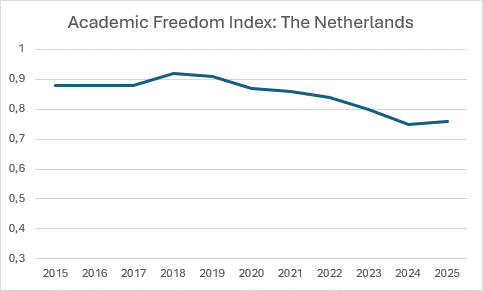
© HOP, source: Academic Freedom Index.
Nuance
A high score doesn’t always mean that the country in question offers a safe learning environment in practice. For example, Nigeria scores significantly higher than the Netherlands, even though students and staff there have been repeatedly kidnapped by criminal gangs, often for ransom.
The Academic Freedom Index, after all, primarily considers the extent to which governments interfere with institutions. Issues such as crime and general security aren’t typically included.
Trump
The most dramatic decline can be seen in the United States, where academic freedom has plummeted by a whopping fifty percent. Its current score of 0.40 suggests that there is currently less academic freedom in America than there was in the Netherlands during World War II.
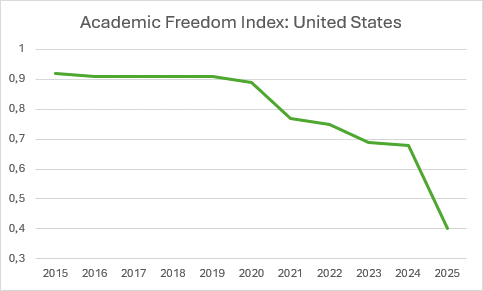
© HOP, source: Academic Freedom Index.
President Trump views universities as adversaries and is exerting substantial financial pressure in an attempt to force them to comply. Researchers are forced to adhere to strict guidelines on diversity, equality and inclusion, while lecturers aren’t allowed to teach freely on topics such as racism and gender; at a university in Texas, even texts by Plato were removed from a course reading list.
The report notes that in Hungary, India and Turkey, academic freedom is also increasingly compromised as a result of legislative changes and government interventions. Unlike in the United States, where the decline occurred rapidly, these countries have experienced a more incremental deterioration.