

During the current academic year, nearly 130 thousand international students were enrolled in a full Bachelor’s or Master’s programme in the Netherlands. New figures released by Nuffic show that international enrolments are down by 133 compared to 2024/2025.
The previous increase in the number of international students had already levelled off in recent years. Three years ago, growth stood at 7 percent – two years ago it had declined to 5.4 percent, and last academic year it was 3 percent. Now there has been a slight decline.
This is because fewer and fewer international students are enrolling in degree programmes in the Netherlands. The number of applications for Bachelor’s programmes fell by 3 percent at universities of applied sciences and by 4 percent at universities. Nuffic expects that this will result in a further decline in the total international student population in the coming years.
German students
Although they still make up the largest group of internationals, the number of German students in the Netherlands has been falling for years. In 2021, there were still 24.6 thousand German students in the Netherlands, but this year that figure has fallen to just 18.2 thousand. German enrolments have declined for the fifth year in a row.
The first decline, in 2021/2022, may have been due to Germany changing the training requirements for psychotherapists, according to Nuffic, but population decline may also be a factor. Still, that doesn’t seem to be the whole story, as enrolments of German students are actually on the rise in other countries, such as Portugal and France.
Ellen Tomesen, head of the science and education team at the Dutch embassy in Berlin, highlights the persistent shortage of student accommodation in the Netherlands. The nationwide suspension of active recruitment of international students could further strengthen the downward trend.
Chinese students
The total number of students from the European Economic Area (EEA) remains stable for the time being, as there are more new students from Southern and Eastern Europe. For example, the number of applications from Spain rose by 28 percent. Among students from outside the EEA, the number of Chinese students – who make up the largest group of non-European internationals – is falling in particular. New enrolments of Chinese students decreased by 28 percent.
According to Nuffic, this may be due in part to the fact that Chinese universities are performing increasingly well in international rankings, which means that students are more likely to stay in their own country. Moreover, China is also seeing a decline in its youth population. After China, Turkey and India account for the largest groups of non-EEA students.
Technical programmes
At universities, technical degree programmes did see a growing number of international students. Delft and Eindhoven are therefore the only universities where the number of international students still increased this academic year, by 8 and 19 percent, respectively. All other universities saw declines, with the exception of Erasmus University, where the number of internationals remained virtually unchanged.
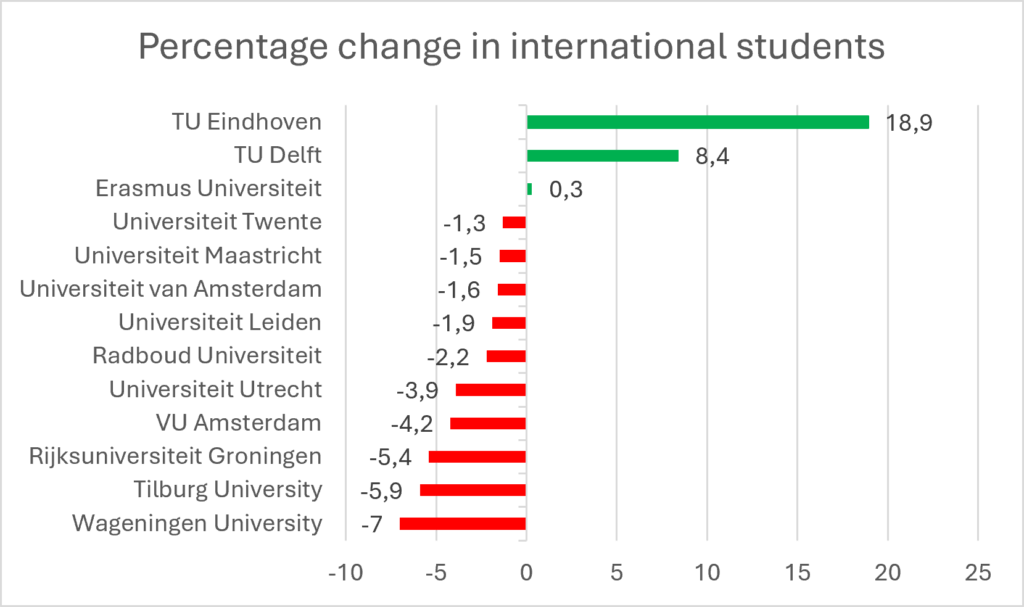
© HOP. Source: Nuffic.
Among the universities of applied sciences, Fontys has the highest number of international students, at around six thousand. Utrecht University of Applied Sciences saw the largest relative increase (13 percent), while Rotterdam University of Applied Sciences and Saxion University of Applied Sciences each recorded a 4 percent fall.
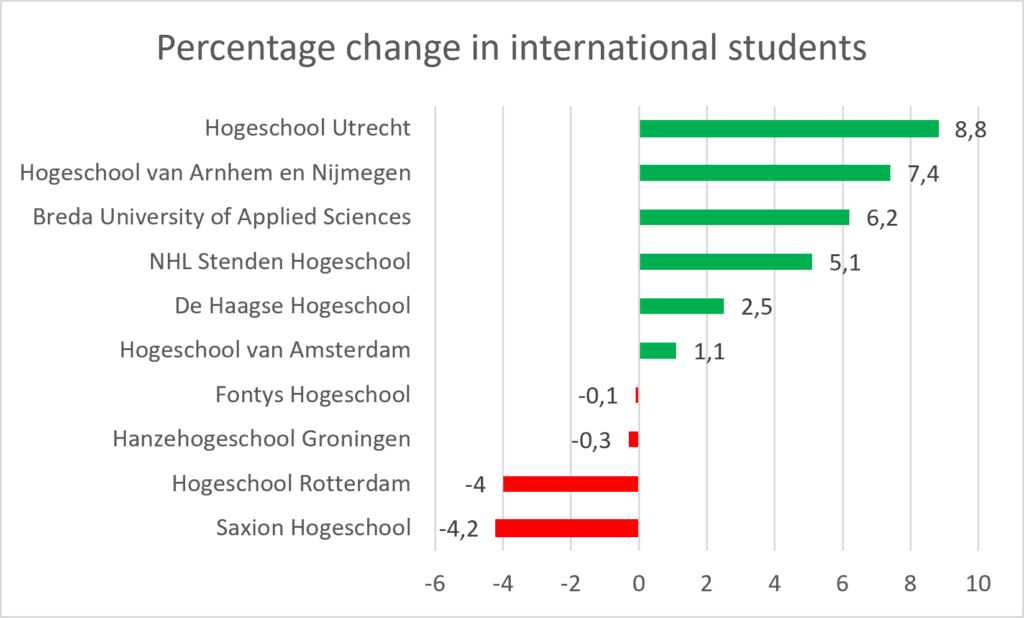
© HOP. Source: Nuffic, the ten universities of applied sciences with the highest number of international students.
This academic year, international students account for around 16.8 percent of the total student population in the Netherlands. This figure is slightly higher than last year, as the number of Dutch students in higher education is falling even more rapidly.