
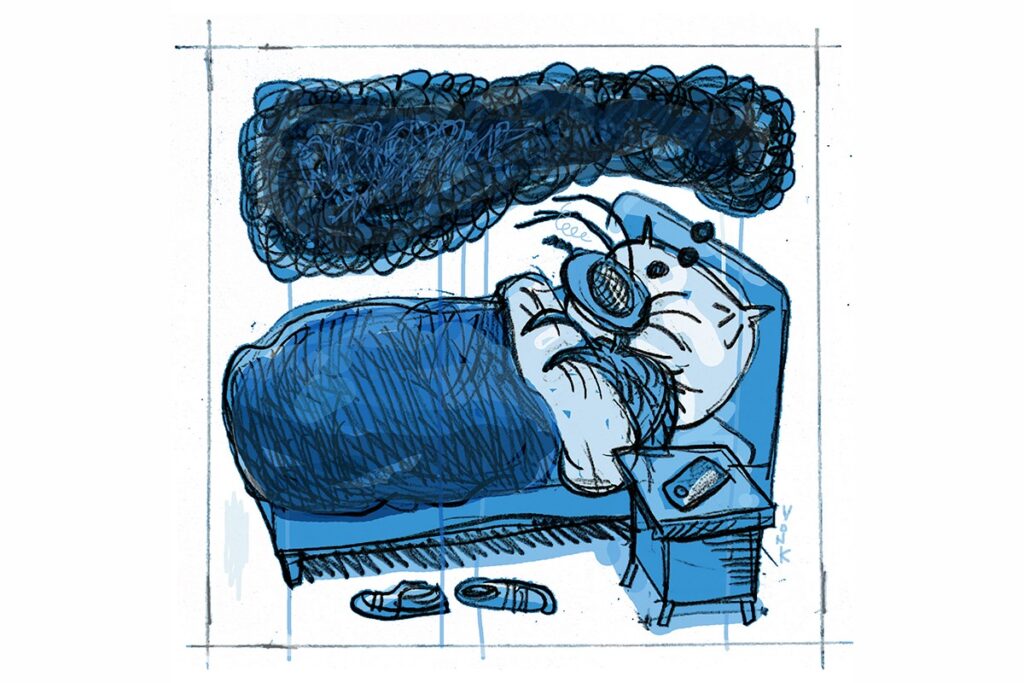

“The pressure to deliver part of my work is incredibly high”, says a postdoc in Social Sciences at VU. “The project is stuck, but my supervisors still expect me to produce publishable results soon. I have no idea how I’m supposed to meet those expectations.” The postdoc, who wishes to remain anonymous, sleeps badly because of it. She is pregnant and worries about what all those stress hormones might do to her unborn child. She will soon go on maternity leave and has no idea how she is supposed to finish her work before then. “I’ve tried many times to explain where the project is running into problems, but it feels as though my supervisors don’t want to hear it.”
Severe depression
Unfortunately, she is no exception. On average, postdocs experience a great deal of work-related stress, according to research by Professor of Organizational Sciences Christine Teelken. Her data show that the situation has worsened in recent years: in 2019, VU postdocs rated their wellbeing at an average of 4.7 on a scale from 1 to 7. In 2025, this had dropped to 2.47 – more than two points lower – according to the research carried out by Teelken and her colleagues Inge van der Weijden and Romy van der Lee. This deterioration surprised the researchers themselves as well. “There is more attention to the issues postdocs face, for example from HR departments, but apparently that is not enough.”
For 42% of postdocs, the problems are so severe that there are serious concerns about their mental wellbeing (in 2020 this figure was 39%). They mainly suffer from depressive symptoms and anxiety. A third of postdocs report sleep problems, and about half are under constant tension. These figures are higher than in the general population. The problem is international. Postdocs in Germany also experience high levels of stress: a study by the Max Planck Institute among 872 of its own postdocs showed that nearly a third suffer from moderate to severe depression, and a quarter from moderate to severe anxiety.
The postdocs in Teelken’s study point to their working conditions as the main cause of their stress: job insecurity, heavy workloads, internal competition that poisons the working atmosphere, favoritism, and poor supervision are frequently mentioned. While they are generally positive about the content of their work, they are far less satisfied with the organization and working conditions. ‘I feel like a disposable’, one of them writes.
Vunlerable phase
“The postdoc phase is the most vulnerable phase of an academic career”, says Teelken. “Postdocs often start out in a new country, there is less supervision and fewer facilities than for PhD candidates. They are often on their own.” Their contracts are also shorter than those of PhD candidates, and they are at a stage in life when questions about whether or not to have children become more pressing. Some find that colleagues and supervisors are reluctant to invest in them because they will be gone again in a few years. Openly complaining is not an option. If they ever want a permanent academic position, they depend on references from their supervisors.
“Prospects for a permanent job are downright bleak”, says a postdoc in the Exact Sciences. For her, the main source of stress is that she is expected to do a substantial amount of work within the project she was hired for, while at the same time needing to do additional things to improve her chances of securing a permanent academic position. That is why she maintains contacts in the research field in which she completed her PhD and attends conferences that do not directly fall within her current field. And all of this alongside raising a family with two young children.
‘Prospects for a permanent job are downright bleak’
Both postdocs we speak with for this article feel they cannot afford to make any wrong choices. The social scientist sometimes wonders whether coming to the Netherlands was the right decision. Had she stayed in her home country, she could have obtained a permanent position as an assistant professor straight away. “But my Dutch husband and I had agreed that we would move to the Netherlands after my PhD.” She tells herself that moving to another country is always difficult, but still she finds it harder than she expected. Lately she has been crying a lot and waking up at night – she thinks it’s a combination of pregnancy hormones and stress.
An invisible group
Postdocs are a relatively invisible group in academia. They are not working toward a PhD anymore, and they usually have short-term contracts of two or three years, sometimes even just one year. Still, they carry out an enormous amount of work. They take on a large share of short-term research projects, they teach, and sometimes they supervise PhD candidates. When their contracts end, they are replaced by a new generation of postdocs. You could call them the worker bees of the university.
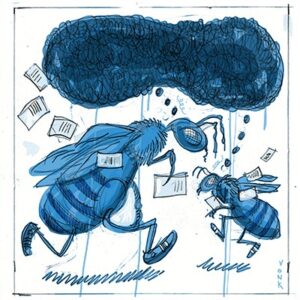
The exact number of postdocs at VU isn’t even known. Teelken explains: “In the UFO system (the system used to register university positions), the postdoc position does not exist. You have the UFO categories ‘Researcher 3’ and ‘Researcher 4’ – many of those are postdocs, but not all.” At VU there are around 700 researchers in these two profiles; Teelken estimates that about two thirds of them are postdocs.
Uncertainty and hard work are manageable for a few years, as long as you know there is an end in sight. But young scientists are having to wait longer and longer for a permanent academic position. “The boundary of uncertainty keeps shifting”, says Teelken. The oldest postdocs in her research are well into their forties. Years of uncertainty weigh heavily on scientists and influence their life choices. In her survey, Teelken encountered female scientists who do not have children and later regretted it.
Giving up the dream
For the two postdocs we spoke to, the prolonged uncertainty is a major source of stress. “It’s stressful to constantly be thinking about what your next step should be”, says the natural scientist, “to be continually applying for jobs and writing grant applications, each time slightly different; to imagine what it would be like to live in yet another country; to ask yourself what the best move is for your career, but also for your family. I love the international vibe of science, but there is a limit to how long I can keep this up.”
The social scientist also sometimes considers giving up her academic career because of the uncertainty and stress that come with it, though not because she wants to. “Since I was nineteen, I’ve been working toward an academic career”, she says. “It would be very hard for me to give up that dream, but sometimes I feel so overwhelmed that I don’t see any other option.”
This highlights another aspect of this group: postdocs are generally highly motivated and enthusiastic about their work. “Postdocs are incredibly valuable; they often underestimate how important they are”, says Teelken. “We need to value them more. I understand that universities cannot offer everyone a permanent contract, but it is time for more attention and better support for postdocs, because they do indispensable work.”
Tips for postdocs
Don’t let yourself be exploited; be aware that you are important to research
Organize yourselves: connect with other postdocs and build a network together
Be aware that there is also strong demand for highly educated people outside academia
Source: Christine Teelken, Professor of Organizational Sciences.
For this article, Ad Valvas spoke with two postdocs who wanted to share their experiences anonymously. Their identity is known to the editorial staff. The inaugural speech of Christine Teelken will take place on 13 February.