

As early as primary school, pupils of Chinese origin are more often given a recommendation to enrol in senior general secondary education (HAVO) or pre-university education (VWO). They also perform well in secondary education: around three quarters attend HAVO or VWO, new figures from Statistics Netherlands (CBS) show. That’s one and a half times the Dutch average.
Many then go on to higher education. Amongst 25- to 45-year-olds, 61 percent of men and 73 percent of women hold a degree from a higher education institution. That’s around 20 percentage points more than amongst their peers of Dutch origin.
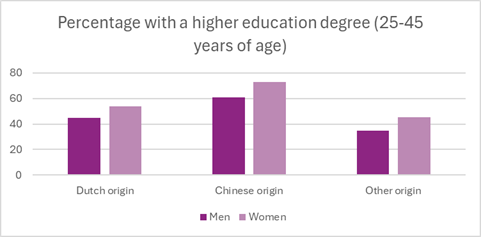
People of other foreign origins are less likely to hold a degree from a higher education institution. One important reason, writes CBS, is that their parents earn less, which generally offers fewer opportunities to pursue higher education.
Students of Chinese origin relatively often choose degree programmes in mathematics, physics and computer science. Amongst men, this applies to just over a quarter. Amongst women, it’s around fifteen percent. By way of comparison, only six percent of female students of Dutch origin choose a degree in this field.
Older mothers
But why do pupils of Chinese origin often do better in education than pupils of Dutch origin? Amongst pupils who were born in China (i.e. migrants), the fact that their mothers tend to be older plays a role. Children of older mothers more often attain a higher level of education. In addition, their parents often have a higher income, which also increases educational opportunities.
Second-generation pupils (with one or both parents born in China) are less likely to live in large cities. In large cities, children are on average less likely to attend HAVO or VWO. Even so, CBS cannot fully account for why Dutch people of Chinese origin perform better on average in education.
Tiger mothers
CBS doesn’t mention it, but upbringing may also play a role. Chinese-American author Amy Chua, for example, described in her book Battle Hymn of the Tiger Mother how performance-oriented she raised her daughters, in line with the tradition of Chinese ‘tiger mothers’. These high demands also extended to the academic sphere.