
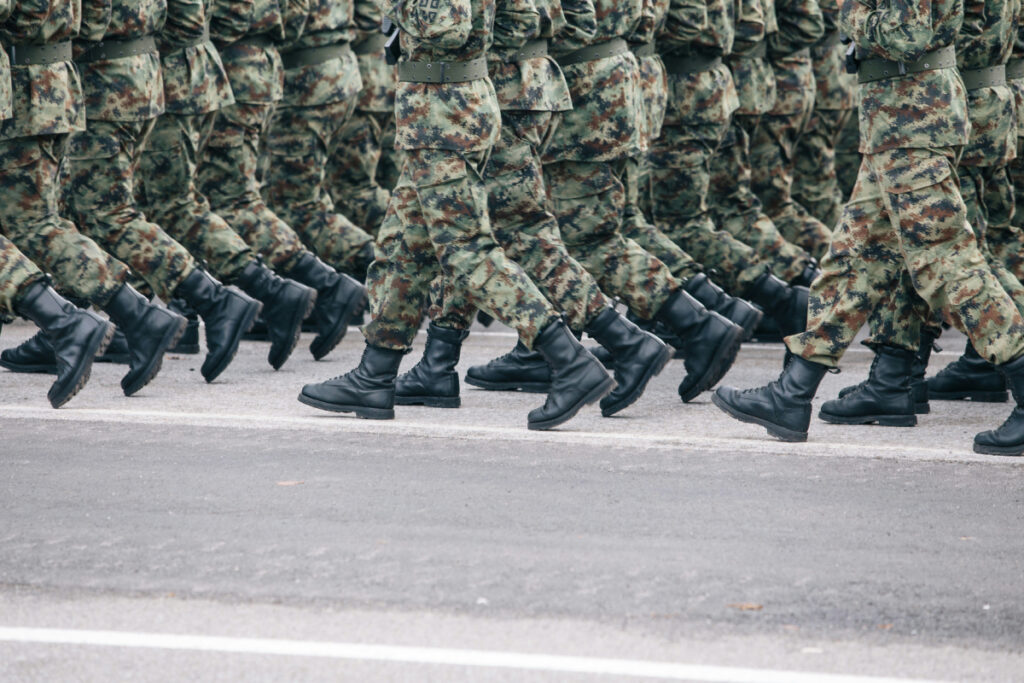
Ad Valvas reported on November 27 the plan of the VU administration to strengthen collaboration with the Ministry of Defence by creating a ‘Center for Defence and Resilient Society’. This plan to open the center as soon as February this year was reported on the VU Amsterdam website in a very brief and vague article, presumably brief and vague in anticipation of significant unpopularity among employees and students at the VU.
The plan, which is sugar-coated with phrases such as ‘making society resilient’, ‘against polarization’, and ‘in order to initiate dialog’ (which are quotes from the Ad Valvas article), is an allocation of public resources away from constructive purposes such as health, nutrition, housing, and education toward militarisation, which will ultimately make our society less safe.
Generation of income
Unlike the details of the plan, the motivation is not disguised. The Ad Valvas article states in the leading paragraph that it is ‘in order to generate income’. As we at universities across the Netherlands are all well-aware of, higher education is facing devastating budget austerity and further cuts that threaten layoffs for thousands of university employees across the country (assuming that all universities face a similar number of layoffs as expected for the VU).
Concurrently, annual military spending increased from approximately 16 billion euros in 2023 to 24 billion (a 50 percent increase) between 2023 and 2025. The latter figure corresponds to 2.2 percent of the projected GDP for 2025 (1.1 trillion EUR according to projections by the European Commission). According to a Government of the Netherlands webpage, the government supports NATO’s target of 5 percent GDP spending by 2030.
The budget deficit projected for the VU from 2025-2028 is 60 million EUR. Based on the rough assumption that each of the 14 universities in the Netherlands face the same projected deficit, this corresponds to a total of 280 million euros per year for all universities over that period. This is less than 0.03 percent of the projected 2025 GDP, or just over 1 percent of the military budget.
Death spiral
In response to the draconian higher-education budget cuts passed by the former government, education minister Eppo Bruins infamously stated: “That is because the cabinet has other priorities. Defense, but also purchasing power and also looking after the treasury. I can live with those priorities, that is also the reason why I said yes to this position” (English version of his quote from an article on the website of the Algemene Onderwijsbond). The higher education budget is being cut in order to increase military spending. The VU’s plan to mitigate the devastating impacts of budget austerity for higher education by collaborating with the ballooning military industry is not only ironic, it is a political death spiral.
Our current crisis at universities across the Netherlands, which may lead to the loss of thousands of jobs and further erosion of the quality and breadth of research and education, is result of undemocratic political decisions regarding the allocation of public resources. We are a vastly productive society with the 4th highest GPD per capita in the European Union according to the Centraal Bureau voor de Statistiek (“CBS”). We often hear alarmist discussions about deficit spending and national debt. The alarmism is justified if we consider what the source of the debt is and if it ultimately falls on the shoulders of the vast majority of the population through austerity in public spending.
While we fret over deficit spending of 2.1 percent of GDP and prepare for mass layoffs in higher education because of a projected annual deficit of 0.03 percent of GDP, gross corporate profits recently constituted 35 percent of GDP (358 billion EUR in 2023 according to a report by CBS), and the military budget may balloon to 5 percent of GDP by 2030. This is ultimately a misdirection of valuable resources that could be used for constructive social purposes into the pockets of a small fraction of the population and toward destructive purposes. Furthermore, it will not make our society safer. Engaging in and amplifying a global military escalation will make us less safe.
Resilience and security
A quote from the November 24 VU report exemplifies this irony and contradiction: ‘Especially in a time where technological developments follow each other at breakneck speed and geopolitical tensions and polarization create division and instability, investing in resilience and security is essential’.
This mentality ultimately perpetuates and amplifies geopolitical tensions and polarization. This amounts to the logic that war is peace. What is ultimately the motivation of such a position? The most generous possible interpretation of the motivation is that we want to enhance our military strength to triumph in the next “great war”. Most of us alive today did not directly experience the last “great war” in Europe. Many friends, family, and neighbours in our society have experienced wars in their homelands. I cannot speak first-hand of their experiences. I think it is safe to say in the lightest of terms that none of us want to experience war. We must not casually flow with the narrative that this is inevitable and that we must prepare to engage in it, and thereby escalate towards it. We should fight with fully justified desperation against it.
Fight to preserve
By enacting layoffs, such as the HR Recruitment Services employees quietly dismissed earlier this year, and planning for further ones, such as in the Earth Sciences and Communications and Marketing department, the VU administration has demonstrated its willingness to enforce the austerity budget that universities across the Netherlands are facing. Albeit deeply cynical, the simultaneous pivot to collaboration with the Ministry of Defence seems logical: direct the university’s efforts to where the money is.
But what are the implications and limits of this logic? We are not a military research institute or training center. We must fight to preserve the role of universities (and public education in general) as centers of research and education for constructive societal purposes. Staff, students, and the general public must stand up and speak up in opposition to this plan.
Thank you for this critical contribution, it’s high time that this debate is held. I suddenly remembered the band ‘Klein Orkest’ which in 1982 wrote in ‘De Laarzen’ (The Boots):
“De burgers van ‘t gezond verstand
De laatste hoop voor Nederland
Geef hen de macht, marcheren maar, de laarzen staan al klaar”
And the cursing poem ‘Peace’ by Leo Vroman, which I probably can’t quote here.
Let’s stay vigilant!